
NATIONAL INDUSTRY ALLIANCE FOR MARINE DRUGS AND BIOPRODUCTS
The demand for patient-oriented health monitoring has created an urgent need for flexible sensing technologies [1]. However, monitoring devices based on conventional sensors often suffer from poor wearing comfort, low measurement accuracy, and disturbance to patient rest [2]. Therefore, developing real-time health monitoring devices that are comfortable, accurate, and non-intrusive to patients' normal rest is of great significance. In recent years, flexible and stretchable electronic devices have shown tremendous potential in wearable healthcare and human–machine interaction [3]. Nevertheless, achieving a balance between high tensile strain and sufficient stress while obtaining high electrical conductivity remains a major challenge in this field. Conductive hydrogels [4], owing to their excellent flexibility and biocompatibility, have emerged as ideal candidates for flexible sensors [5]. Although alternative materials such as intrinsically conductive polymers (e.g., polyaniline [6] and polypyrrole [7]) have been explored to enhance flexibility and sensing capabilities, these materials often suffer from biotoxicity issues. Moreover, achieving high-sensitivity simultaneous detection of multiple physical stimuli within a single material system, while ensuring long-term environmental stability and mechanical reliability, remains challenging. Traditional hydrogel materials are prone to bacterial growth, posing a risk of infection [7], [8], [9]. Therefore, overcoming the limitations of conventional rigid filler-based composite systems and designing a seamlessly integrated flexible sensor that can synergistically respond to multiple physical stimuli and possess antibacterial functionality is still a critical challenge to be addressed in this field.
MXene [10] and liquid metal (LM) [11] are two highly promising conductive fillers, yet both face dispersion challenges when incorporated into composite hydrogel systems. MXene possesses metallic conductivity and a two-dimensional layered structure, enabling it to act as a physical crosslinker through hydrogen bonding with polymer chains, and to dissipate energy under stress via nanosheet pull-out, crack deflection, and dynamic bond rearrangement, thereby significantly enhancing the mechanical properties of the hydrogel [12]. However, the stability of MXene in water relies on electrostatic repulsion from its negatively charged surface. When introduced into an ion-rich precursor solution, the ionic shielding effect disrupts its colloidal stability, leading to nanosheet stacking and agglomeration. To address the challenges of MXene dispersion and oxidation stability, various strategies have been explored. For instance, cellulose nanocrystals (CNC) have been used to stabilize MXene via physical adsorption and hydrogen bonding [13], but their limited surface functionality proves inadequate in ionic environments. Ionic liquid (IL) modification [14] enhances conductivity and hydrophilicity yet involves complex synthesis and biotoxicity concerns. In contrast, sodium alginate (SA), a naturally abundant polyelectrolyte with excellent biocompatibility, can form multiple hydrogen bonds and coordination interactions with the MXene surface through its abundant carboxyl and hydroxyl groups [15], [16], [17] achieving more robust and efficient dispersion. More importantly, the polymeric chains of SA provide steric hindrance that synergizes with its chemical anchoring, effectively suppressing MXene stacking and agglomeration even in ionic environments. On this basis, we employed SA as a stabilizer for MXene and uniformly dispersed it within the PVA/AA double-network hydrogel.
On the other hand, liquid metal (EGaIn) features room-temperature fluidity, ultrahigh electrical conductivity, and a reactive oxide layer. For instance, phytic acid (PA) has recently been employed as a natural small-molecule interfacial stabilizer to disperse LM droplets, wherein its six phosphate groups coordinate with Ga3+ species on the Ga₂O₃ surface layer of LM in a poly(vinyl alcohol) (PVA) crosslinking matrix [18]. As a small-molecule stabilizer, however, PA relies on a single coordination mode to anchor the LM surface and lacks the steric hindrance effect provided by polymeric chains, rendering it inadequate to suppress the migration and aggregation of LM nanodroplets during prolonged storage or gelation. To overcome these obstacles, a study reported a multifunctional flexible hydrogel sensor (CMC-LM-LS/PAA system) based on carboxymethyl cellulose (CMC)-regulated dispersion of LM droplets and sodium lignosulfonate (LS)-assisted interfacial stabilization [19]. In this work, LM droplets were uniformly dispersed in a poly(acrylic acid) (PAA) network scaffold, constructing a conductive hydrogel with ion conduction as the dominant mechanism. The introduction of the CMC-LM-LS complex improved ion mobility and structural stability, enabling the hydrogel to maintain stable electrical signal output under mechanical deformation and temperature variations. This work overcomes the limitation of previous approaches that relied solely on small-molecule stabilizers for LM dispersion [20], [21], [22], and provides a novel composite dispersion strategy combining “small-molecule anchoring [23]“with “polymeric steric hindrance [24],” offering a new design paradigm for the long-term stable application of liquid metals in flexible electronic devices.
On this basis, we developed a flexible hydrogel sensor for patient health monitoring. The hydrogel comprises a thermally initiated PVA/AA double network, with borax providing dynamic borate ester bonds and choline chloride (ChCl) acting as a hydrogen bond acceptor to ensure mechanical robustness and reversibility. MXene nanosheets are stabilized by SA via hydrogen bonding and coordination, while LM droplets are uniformly dispersed using a composite system of hydroxyethyl cellulose (HEC) [25] and LS. In this system, LS anchors LM droplets through coordination bonds between its sulfonate/phenolic hydroxyl groups and Ga3+ on the LM surface, while HEC provides steric hindrance and hydrogen bonding sites to form a protective polymeric layer, ensuring stable dispersion even under ionic and mechanical stress. Within the network, uniformly dispersed MXene and LM construct a “point to plane” conductive pathway: MXene sheets form an electron conducting backbone, while deformable LM droplets fill inter sheet gaps to maintain conductivity under stretching. Both fillers interact with the polymer network via multiple hydrogen bonds and coordination, synergistically enhancing mechanical and electrical performance. The electrical response arises from combined electron conduction (MXene) and ion migration (ChCl). The incorporation of SA stabilized MXene and HEC/LS stabilized LM improves charge transport and interfacial stability, enabling stable signal output under deformation and temperature changes. The resulting PACML hydrogel exhibits a wide working range (strain up to 1352%), high sensitivity (conductivity of 3.65 S/m), excellent mechanical properties (tensile strength of 180.8 kPa, elongation at break of 1352%), as well as good antibacterial activity and biocompatibility. This work provides a simple and effective strategy for stable LM/MXene composite hydrogels toward multifunctional wearable applications.
Poly(vinyl alcohol) (PVA205, Mw = 27,000 g/mol, degree of hydrolysis = 98%) was supplied by Qihua New Chemical Materials Co., Ltd. (China). Acrylic acid (AA, C₃H₄O₂, ≥99.5%, Mw = 72.06 g/mol), choline chloride (ChCl, C₅H₁₄ClNO, 99%, Mw = 139.62 g/mol), N,N′-methylenebisacrylamide (MBAA, C₇H₁₀N₂O₂, 99%, Mw = 154.17 g/mol), and sodium alginate (SA, viscosity = 200 ± 20 mPa·s) were all of analytical grade and purchased from Sinopharm Chemical Reagent Co., Ltd. (China). Borax (Na₂B₄O₇·10H₂O, 99%, Mw = 381.37 g/mol) was supplied by Shanghai Macklin Biochemical Technology Co., Ltd. (China). Sodium lignosulfonate (LS, 95%) was purchased from AmBeed (China). Hydroxyethyl cellulose (HEC, viscosity = 1500–2500 mPa·s), liquid metal (LM, gallium‑indium alloy, Ga 75.5 wt% / In 24.5 wt%, purity ≥99.99%), and potassium persulfate (KPS, K₂S₂O₈, 99%, Mw = 270.32 g/mol) were purchased from Shanghai Aladdin Biochemical Technology Co., Ltd. (China). The Ti₃AlC₂ MAX phase material (purity ≥99%) was obtained from Xinxi Technology Co., Ltd. (China).
The MXene (Ti3C2Tx) suspension was prepared following a previously established chemical etching method. First, 3.2 g of LiF powder, and 40 mL of 9 M HCl solution were combined in a Teflon container and stirred magnetically at room temperature for 15 min. Next, 2 g of Ti3AlC2 powder was gradually added to the solution, which was continuously stirred at 35 °C for 48 h. After the reaction, the resulting suspension was washed with deionized water and centrifuged multiple times until the pH stabilized at approximately 6. The collected black precipitate was redispersed in deionized water, subjected to ultrasonic treatment in an ice bath (100 W, 30 min), and centrifuged again to isolate single-layer MXene sheets.
0.3, 0.5, 0.7, and 0.9 g of LM were respectively added to 15 mL of deionized water containing 0.02 g of LS and 0.1 g of HEC. The mixtures were dispersed by probe ultrasonication (300 W, 60 min, ice-water bath) to obtain LM@LS/HEC dispersions with different LM loadings, denoted as LM-0.3, LM-0.5, LM-0.7, and LM-0.9.
13.3 mL of 10 wt% PVA aqueous solution was transferred into a 50 mL beaker, and 1.67 mL of 2 wt% aqueous borax solution was slowly added dropwise under gentle magnetic stirring. The mixture was then gently stirred at room temperature for 30 min until homogeneous, yielding approximately 15 mL of the PVA–borax base solution. 2 mL of 2 wt% SA aqueous solution was mixed with 2 mL of MXene dispersion (24 mg/mL) under magnetic stirring to obtain a homogeneous MXene@SA composite dispersion. Separately, a base solution was prepared by dissolving 2.5 mL of acrylic acid (AA) in 15 mL of an aqueous solution containing PVA–borax base solution under stirring. To this base solution, 0.2 g of ChCl, the as-prepared MXene@SA dispersion (4 mL), and 2 mL of the LM@LS/HEC dispersion with a specific LM loading (prepared as described in Section 2.2) were added successively with thorough stirring. Subsequently, 5 mg of MBAA (chemical crosslinker) and 20 mg of KPS (thermal initiator) were added and stirred until completely dissolved. The precursor solution was quickly poured into a mold and heated at 60 °C for 6 h. After the reaction, the obtained hydrogel was washed with copious deionized water to remove unreacted monomers and residual reagents. The samples were denoted as PACML-x, where x represents the LM loading from Section 2.2. The detailed compositions of all prepared hydrogel samples are summarized in Table S1. Control samples were prepared as follows: PACM (without LM), PAC (without MXene and LM), and PA (without MXene, LM, and ChCl).
The microstructure of the synthesized hydrogels was observed using scanning electron microscopy (SEM; Quanta-450). Prior to imaging, the hydrogel samples were freeze-dried and sputter-coated with a thin gold film. The microstructures of monolayer MXene nanosheets and LM dispersions were characterized by transmission electron microscopy (TEM; Tecnai F20, USA).
Fourier transform infrared spectroscopy (FTIR; Thermo Fisher Scientific Nicolet iS20, USA) was performed in the wavenumber range of 400–4000 cm−1 to analyze the functional groups and chemical interactions within the hydrogels. Thermal stability was evaluated using thermogravimetric analysis (TGA) on a Mettler Toledo TGA/DSC3+ instrument. Freeze-dried hydrogel samples (5–10 mg) were placed in alumina crucibles and heated from room temperature to 800 °C at a constant rate of 10 °C/min under a nitrogen atmosphere. The corresponding TGA and derivative thermogravimetric (DTG) curves were plotted for further analysis.
Mechanical tests were performed on a universal testing machine (UTM5504, Sansi, China). For tensile tests, a 200 N load cell was used, and hydrogel samples with a width of 2 mm and thickness of 1.3 mm were stretched at a rate of 100 mm·min−1. In uniaxial tensile tests, dumbbell-shaped hydrogel specimens (length 22 mm × width 2 mm × thickness 1.5 mm) were tested using the universal testing machine with a constant crosshead speed of 100 mm·min−1 for both loading and unloading. The maximum load capacity of the instrument was 100 N. Tensile strength was determined by dividing the fracture load by the original cross-sectional area of the specimen. Tensile strain (ε) was defined as the elongation relative to the initial gauge length. Young's modulus was calculated from the slope of the initial linear region (0–20% strain) of the stress–strain curve. Toughness, representing the energy absorbed per unit volume before fracture, was obtained by integrating the area under the entire stress–strain curve.
The adhesion strength of the hydrogel was evaluated using a lap shear test on the universal testing machine. Rectangular hydrogel samples were firmly adhered to different substrates (rubber, wood, paper, and metal) and then peeled at a constant speed of 50 mm·min−1. Adhesion strength (kPa) was calculated by dividing the peak peeling force by the sample width. For cyclic adhesion tests, the same peeling procedure was repeated continuously 10 times on a metal substrate, with a 1 min recovery interval between each cycle. The adhesion strength of each cycle was recorded to assess durability. For all mechanical and adhesion tests, at least three independent samples were tested for each formulation or condition. The experimental data are presented as mean ± standard deviation.
The conductivity of the hydrogel was assessed using electrochemical impedance spectroscopy on an electrochemical workstation (CS350H, Corrtest). A cylindrical hydro-gel sample was positioned between two copper electrodes, which were connected to the positive and negative terminals of the workstation. A sinusoidal voltage with an amplitude of 0.01 V was applied across a frequency range from 10−2 to 105 Hz. The conductivity (σ) of the hydrogel was determined using the following formula(1)(1)
The electromechanical performance was characterized by coupling a stepping motor (model 57HBP56AL4-TF8A) with an electrochemical workstation (CS350H, Corrtest) for simultaneous strain application and electrical signal acquisition. To detect the sensing performance, the hydrogel was subjected to different external stimulus factors. Also, the change ratio of resistance was recorded using the following Eq. (2):(2)
The strain sensitivity of the sensor was quantified by gauge factor (GF), which was the ratio of relative resistance change (ΔR/R0) to the strain (ε). The value of GF was calculated by Eq. (3):(3)
The biocompatibility of the samples was assessed through live/dead staining of human fibroblasts, utilizing the Calcein/PI Cell Viability and Cytotoxicity Assay Kit (Beyotime). Prior to the experiment, in order to ensure the sterility of the gel, it was washed with double-distilled water (DDW) and subsequently irradiated under an ultraviolet lamp for 30 min. Three identical gel discs (diameter: 15 mm; height: 1.5 mm) were prepared from a single sample. These discs were then placed in 20 mL of Dulbecco's Modified Eagle Medium (DMEM) supplemented with 10% fetal bovine serum and incubated at 37 °C for 24 h to prepare the extraction solution. Human dermal fibroblasts were seeded into 48-well plates at a density of (2 × 10⁴) cells per well and pre-cultured for 8 h under standard conditions (37 °C, 5% CO2). Following this incubation period, the medium was replaced with the gel extract, and cells were further incubated for durations of 24, 72, and 120 h respectively. Subsequently, cell staining was performed using the Calcein/PI kit, after which cell viability was observed under a fluorescence microscope to evaluate the biocompatibility of the gel samples.
Two representative bacterial strains, Escherichia coli (Gram-negative) was selected to evaluate the antibacterial performance. Single colonies were inoculated into 5 mL of Luria-Bertani (LB) liquid medium and cultured at 37 °C with shaking at 180 rpm for 8–10 h to reach the logarithmic growth phase. The bacterial suspensions were then diluted to appropriate concentrations with phosphate-buffered saline (PBS, pH 7.4). Prior to testing, all materials were thoroughly dried and sterilized by UV irradiation for 30 min.
The antibacterial efficacy of different samples was initially assessed using the spread plate method. Briefly, 100 μL of each sample (1 mg·mL−1) was mixed with LB medium, followed by the addition of 100 μL of the diluted bacterial suspensions (1 × 10⁶ CFU·mL−1) of E. coli and S. aureus. The mixtures were co-cultured under specified conditions. After incubation, 100 μL of the bacterial suspension was extracted, spread onto LB agar plates, and cultured at 37 °C for 24 h. The colony-forming units (CFU·mL−1) were counted, and the bacterial survival rate was calculated as the ratio of the bacterial concentration in the treated group to that in the control group. Additionally, the log₁₀ value of the inverse survival rate was calculated to further evaluate the antibacterial efficiency.
The water retention performance of the hydrogels was evaluated by monitoring their weight changes under ambient conditions. Three rectangular hydrogel specimens (1 × 3 cm) were exposed to air at room temperature, and their weights were recorded at predetermined time intervals of 1, 4, 12, and 24 h. The water retention rate (WR) was calculated according to the following equation:(4)where and are the initial weight and the weight at time , respectively. Data are presented as mean ± standard deviation (n = 3).
MXene possesses abundant polar functional groups on its surface, rendering it highly prone to interlayer stacking and aggregation through hydrogen bonding or van der Waals forces. Meanwhile, LM is also difficult to stably disperse in hydrogel precursors due to its high surface tension and the presence of a native oxide layer. To address these issues [26], SA and a HEC/ LS composite system were introduced as dispersants for the two fillers, respectively. As illustrated in Fig. 1a, the abundant carboxylate groups (–COO−) on SA chains adsorb onto the MXene surface through hydrogen bonding and coordination interactions (Ti–O–C), forming a stable coating layer. This coating provides steric hindrance while also imparting additional negative charges to the MXene surface [27], thereby maintaining colloidal stability in the ion-rich precursor environment. With the assistance of SA, MXene can be uniformly dispersed in the PVA/AA double-network matrix as single or few-layer nanosheets, laying the foundation for subsequent synergistic construction of conductive pathways with LM. On the other hand, as shown in Fig. 1b, LS firmly anchors onto the LM droplet surface via coordination bonds between its sulfonate and phenolic hydroxyl groups and Ga3+ from the native Ga₂O₃ layer, providing electrostatic repulsion. Meanwhile, HEC chains adsorb onto the LS-modified LM surface through hydrogen bonding and chain entanglement, offering steric hindrance and increasing the viscosity of the continuous phase. This synergistic effect effectively prevents LM droplet aggregation and sedimentation, ensuring a homogeneous distribution of LM within the hydrogel matrix.
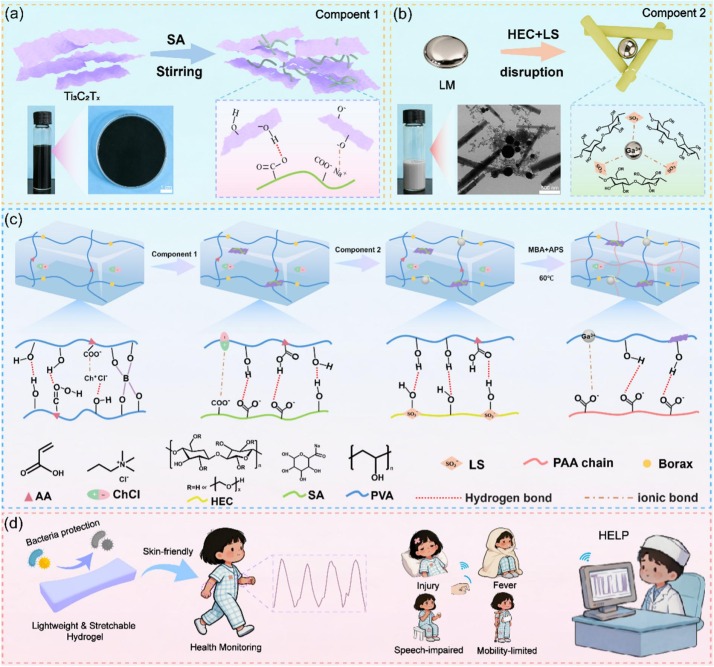
Fig. 1. Fabrication process of the PACML hydrogel. (a) MXene@SA, (b) LM@HEC/LS (c) hydrogel formation, and (d) Multifunctional applications of the hydrogel in various scenarios.
The formation of the hydrogel underwent four consecutive stages of bonding and crosslinking, as illustrated in Fig. 1c. In the first stage, PVA reacted with B(OH)₄− generated from borax hydrolysis to form dynamic borate ester bonds, establishing a reversible covalent crosslinking network. Meanwhile, hydrogen bonding occurred between AA monomers and PVA chains, and ChCl, acting as a hydrogen-bond acceptor, engaged in ion–dipole and electrostatic interactions with the hydroxyl groups of PVA and the carboxyl groups of AA. In the second stage, the MXene@SA filler was introduced: the abundant carboxylate groups (–COO−) of SA formed hydrogen bonds and coordination bonds (Ti–O–C) with the Ti–O−/Ti–OH groups on the MXene surface, uniformly coating the MXene nanosheets. Additionally, the remaining –COO− groups of SA underwent hydrogen bonding and electrostatic attraction with the PVA/AA/ChCl matrix, firmly anchoring MXene within the network. In the third stage, the LM@LS/HEC dispersion was added: LS formed coordination bonds (Ga–O–S) through its sulfonate and phenolic hydroxyl groups with Ga3+ from the native Ga₂O₃ layer on the LM surface, achieving strong adsorption of LM droplets. Meanwhile, HEC chains associated with LS and the LM surface via hydrogen bonding, providing steric hindrance and increasing the viscosity of the continuous phase, thereby effectively suppressing LM aggregation [13]. In the fourth stage, KPS and MBA were added followed by thermal initiation: free-radical polymerization of AA monomers occurred, and MBA acted as a crosslinker to covalently connect PAA chains, forming a permanent chemical network. This network interpenetrated with the existing PVA–borax dynamic covalent network, hydrogen-bonding network, and filler–matrix coordination bonds. The resulting high-performance hydrogel, featuring good biocompatibility and a multi-crosslinked structure, can be used for patient health monitoring while preventing bacterial growth (Fig. 1d).
The microstructures of the as-prepared MXene nanosheets and LM dispersion were characterized by TEM. The MXene nanosheets, synthesized by in-situ etching of the Ti₃AlC₂ precursor using a LiF/HCl system followed by HF treatment and ultrasonic exfoliation, exhibited a typical two-dimensional lamellar morphology with a lateral size exceeding 500 nm (Fig. 2a). This distinct lamellar structure confirms the successful exfoliation of MXene, indicating a high specific surface area. Furthermore, the TEM image of the LM dispersion (Fig. 2b and Fig. S1) revealed that, under the synergistic dispersion of HEC and LS, the LM droplets displayed a uniform spherical-to-cylindrical alternating morphology without significant aggregation, confirming their favorable dispersion stability (Fig. S2). As shown in Figs. 2c–2f, both the PA and PACML hydrogels exhibited a typical porous network structure, indicating that the introduction of MXene and LM did not significantly alter this porous framework [28]. Notably, after the incorporation of MXene, ChCl, and LM, EDS analysis (Fig. 2g) detected multiple characteristic elements, including Ti, Ga, and Cl, confirming the successful integration of the functional components into the hydrogel network. Furthermore, the water retention test results demonstrated that the PACML hydrogel exhibits excellent water retention capacity, maintaining a relatively high water content even after prolonged storage, thereby providing favorable conditions for its long-term stable application in wearable health monitoring(Fig. S3).
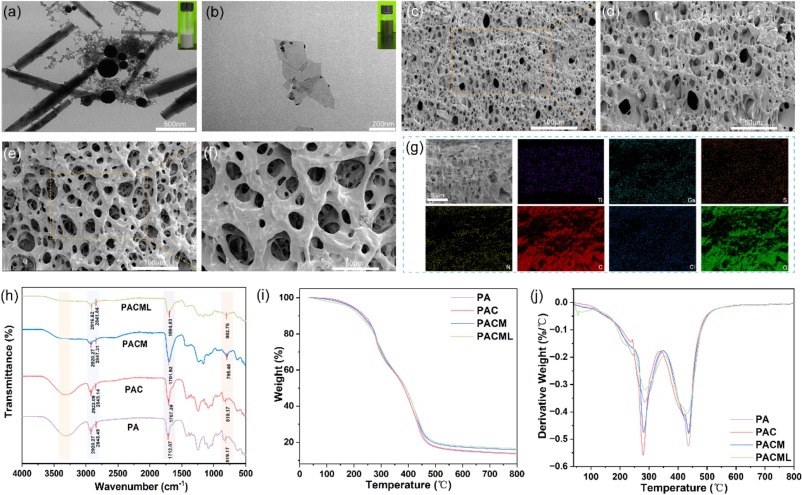
Fig. 2. (a) TEM image of LM@HEC/LS. (b) TEM image of monolayer MXene nanosheets. (c,d) SEM images of PA: (c) 100 μm, (d) 50 μm. (e,f) SEM images of PACML: (e) 100 μm, (f) 50 μm. (g) FTIR spectra of different samples. (h) TGA curves of different samples. (i) DTG curves of different samples.
FTIR spectroscopy was employed to investigate the variations in functional groups and intermolecular interactions within the hydrogels (Fig. 2h). The pristine PVA/AA dual-network hydrogel (PA) exhibited characteristic C H stretching vibrations at 2920.27 and 2845.49 cm−1, a C
 O stretching vibration of carboxyl groups (–COOH) at 1712.87 cm−1, and a band at 819.17 cm−1 corresponding to the CO or CC skeletal vibration of PVA. Upon introduction of ChCl (PAC sample), the CH peaks slightly blue-shifted to 2922.09 and 2849.14 cm−1, indicating ion–dipole interactions between ChCl and the PVA/AA chains; meanwhile, the CO band red-shifted to 1707.39 cm−1, confirming that electrostatic attraction between Ch+ and –COO− reduces the electron cloud density of the carboxyl groups and enhances the hydrogen-bonding network. After adding the MXene@SA filler (PACM sample), the CH bands largely returned to 2920.27 and 2847.31 cm−1, the CO band further red-shifted to 1701.92 cm−1, and a new peak emerged at 795.46 cm−1, which can be attributed to the Ti–O–C coordination bonds formed between SA and the MXene surface or to the C–O–C vibrations of the SA saccharide ring. Subsequent incorporation of the LM@LS/HEC dispersion (PACML sample) resulted in further blue-shifts of the CH bands to 2916.62 and 2841.94 cm−1, and a red-shift of the CO band to 1694.63 cm−1, suggesting that the coordination anchoring of LS and the hydrogen bonding of HEC synergistically enhance the interfacial interactions between the fillers and the polymer network. Notably, from PA to PACML, the OH stretching band in the region of 3500–3000 cm−1 gradually broadened and flattened, indicating that a large number of hydroxyl groups participate in the intermolecular hydrogen-bonding network with a reduction in free hydroxyl groups. This observation is consistent with the formation of a multi‑hydrogen-bonded crosslinking network mediated by ChCl as a hydrogen-bond acceptor and the introduction of hydroxyl-rich components such as SA, HEC, and LS.
The thermal stability and composition of the hydrogels were further evaluated by TGA (Fig. 2i). All samples exhibited multi-stage weight loss curves. The initial slight weight loss below 170 °C was attributed to the evaporation of residual water and physically bound water. The major decomposition stage occurring in the range of 250–400 °C corresponded to the degradation of the polymer backbone components, including PVA, SA and PAA. Notably, the onset decomposition temperature and the temperature corresponding to the maximum weight loss rate of the PACML hydrogel were higher than those of PA and PAC (Fig. 2g). This improvement in thermal stability is attributed to the strong interfacial interactions between the MXene nanosheets and the polymer network, which restrict the mobility of polymer chains upon heating. Furthermore, the residual mass at 800 °C progressively increased from PA to PAC, PACM, and PACML. The higher char yield of PACML is consistent with the presence of thermally stable MXene, further confirming the successful incorporation of MXene into the composite system. Meanwhile, the introduction of LM is also clearly reflected in the residual mass, as LM forms stable metal oxide residues (e.g., Ga₂O₃) at high temperatures, which is consistent with the higher residual mass observed for the PACML sample, thus demonstrating the successful integration of LM.
As a stretchable strain sensor, the PACML hydrogel exhibits excellent tensile properties. Its tensile characteristics were systematically characterized using an electronic universal testing machine. As shown in Fig. 3a, the PA hydrogel (without MXene and LM) exhibits a tensile strength of 54.61 kPa and an elongation at break of 1079%. After introducing ChCl and borax, the PAC hydrogel shows an increased tensile strength of 87.43 kPa, while the maximum strain slightly rises to 1145%. This is attributed to the dynamic borate ester bonds and the hydrogen-bond accepting role of ChCl, which enhance both the stiffness and toughness of the material [29]. With the further introduction of MXene@SA and LM@LS/HEC, the PACML hydrogel exhibits a significantly improved tensile strength of 180.8 kPa and an elongation at break of 1352%, demonstrating that the synergistic incorporation of MXene and LM greatly enhances the mechanical performance. In addition, the crosslinker MBAA and borax also affect the tensile properties of the hydrogel. As a crosslinker, increasing the MBAA content enhances the internal crosslinking degree of the gel, making it stiffer and generally leading to a higher tensile fracture stress but a lower strain at break, whereas the small amount of borax added has only a limited effect on the mechanical properties (Fig. S4a-b).
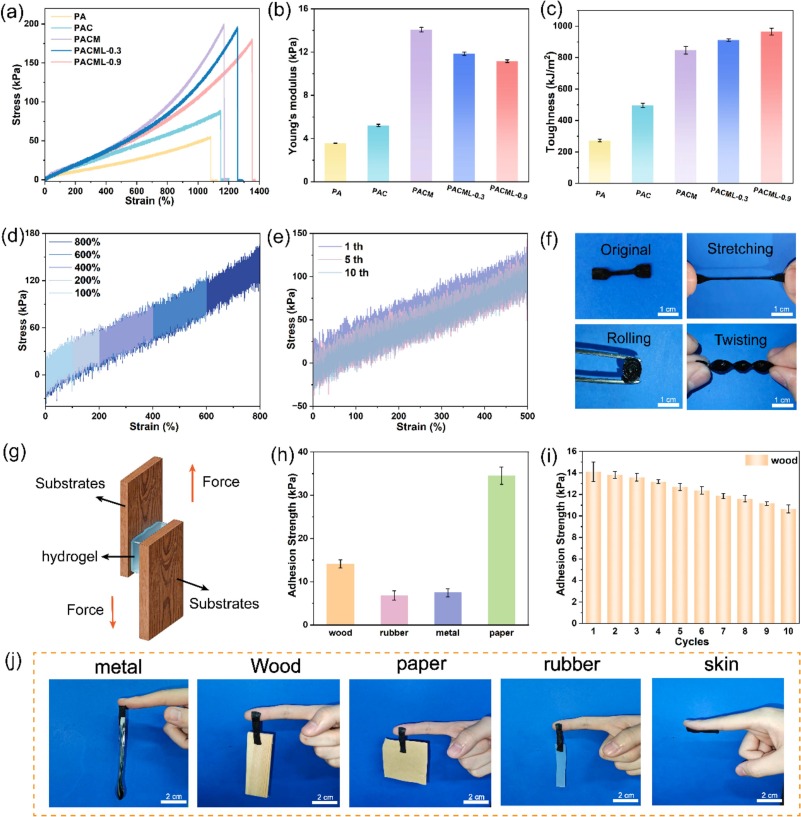
Fig. 3. Mechanical and adhesion properties of the hydrogels. (a) Tensile stress–strain curves of different hydrogels, (b) Young's modulus of different hydrogels, (c) Toughness of different hydrogels, (d) Cyclic tensile stress–strain curves of the PACML-0.9 hydrogel at strains of 100%, 200%, 400%, 600%, and 800%, (e) Force–displacement curves of the PACML-0.9 hydrogel at 500% strain after 10 tensile cycles, (f) Photographs of the PACML-0.9 hydrogel under original, stretched, curled, and twisted states, (g) Schematic illustration of the hydrogel adhesion test, (h) Adhesion strength of the PACML-0.9 hydrogel on different substrates, (i) Adhesion strength of the PACML-0.9 hydrogel on a wood substrate over 10 adhesion–peeling cycles, (j) Photographs of the PACML-0.9 hydrogel adhered to different substrates, including rubber, paper, wood, skin, and metal. All data are presented as mean ± standard deviation.
This substantial improvement in mechanical properties can be ascribed to multiple intermolecular interactions among the components [30]. The Young's modulus and toughness calculated from the stress–strain curves further validate this synergistic reinforcement mechanism. As shown in Fig. 3b, the Young's modulus increases significantly from 3.56 kPa for the PA hydrogel to 11.15 kPa for the PACML hydrogel, indicating that an efficient crosslinking network is formed between MXene and the polymer matrix, thereby enhancing the material's stiffness. Importantly, the toughness of the PACML hydrogel reaches 965.21 kJ/m3 (Fig. 3c), which is markedly higher than that of the PA and PAC hydrogels, achieving an optimal balance in mechanical properties [31], [32], [33].
From a molecular mechanism perspective, the introduction of MXene and LM plays critical roles in modulating the stiffness and toughness of the material, respectively. MXene is rich in surface functional groups such as hydroxyl and oxygen-containing moieties, which can form abundant hydrogen bonds with the carboxyl groups of PAA chains and with SA molecular chains. Meanwhile, the carboxylate groups of SA form coordination bonds (Ti–O–C) with the MXene surface, thereby constructing a high-density physical crosslinking network. These dynamic crosslinking points effectively restrict the movement of polymer chains, significantly increasing the crosslinking density and network uniformity of the hydrogel, which in turn enhances its Young's modulus and tensile strength, i.e., achieves an increase in stiffness. On the other hand, LM, uniformly dispersed as micro-nano droplets with the synergistic assistance of LS and HEC, exhibits deformable characteristics. During stretching, these droplets fill the interlayer gaps of MXene and maintain conductive continuity, while dissipating energy through droplet deformation, thereby endowing the material with excellent toughness. Furthermore, the coordination bonds between LS and the Ga₂O₃ layer on the LM surface (Ga–O–S), as well as the hydrogen bonds and physical entanglements between HEC and the polymer network, further enhance the interfacial interactions. Under large deformation, the breakage and reformation of these dynamic non-covalent bonds (hydrogen bonds and coordination bonds) effectively dissipate energy, preventing premature fracture caused by stress concentration and synergistically improving the elongation at break and toughness [34], [35], [36]. Therefore, the synergistic introduction of MXene and LM enhances the stiffness of the hydrogel while maintaining outstanding toughness, achieving a well-balanced stiffness–toughness trade-off.
Strain sensors require high toughness to prevent fracture and mitigate performance degradation caused by long-term use. Fig. 3e illustrates the cyclic tensile–retraction behavior of the PACML hydrogel under various applied strains. Under higher strain levels (ranging from 100% to 800%), pronounced hysteresis loops observed between the loading and unloading curves indicate a significant energy dissipation capacity of the PACML hydrogel. This energy dissipation behavior originates from the dynamic and reversible non-covalent interactions within the hydrogel network. Upon deformation, the abundant hydrogen bonds and coordination bonds formed between MXene, SA, and the PAA chains, as well as the physical entanglements of polymer chains, are preferentially disrupted, effectively dissipating mechanical energy as heat. Meanwhile, the flexible SA chains and the deformation of LM droplets maintain network integrity. Upon unloading, these disrupted interactions gradually reform, allowing the hydrogel to recover its original structure. This dynamic bond breakage and reconstruction mechanism not only prevents catastrophic failure under large deformations but also ensures structural stability and reliable signal output over repeated loading–unloading cycles. As shown in Fig. 3e, after 10 consecutive tensile cycles at 500% strain, the stress–strain curves exhibit only slight stress attenuation, with the tensile force remaining at approximately 83.84% of its initial value. This result confirms the material's excellent elasticity and fatigue resistance. The outstanding cyclic stability further verifies that the incorporation of MXene and the resulting hydrogen-bonding and coordination networks effectively homogenize stress distribution and enhance energy dissipation, thereby ensuring sufficient flexibility (Fig. 3f) and long-term reliable performance under repeated mechanical loading.
Stable, reversible, and robust adhesion is essential for maintaining conformal contact between hydrogel sensors and dynamic curved surfaces such as human skin. To evaluate this property, we systematically measured the adhesion strength of the PACML hydrogel on various substrates, including rubber, wood, paper, and metal (Fig. 3g). As shown in Fig. 3h, the hydrogel exhibits strong interfacial adhesion on all tested substrates. The highest adhesion strength is observed on paper (34.52 kPa), followed by wood (14.11 kPa), which are significantly higher than those on rubber and metal substrates. Furthermore, cyclic adhesion tests on wood reveal that the hydrogel retains 75% of its initial adhesion strength after 10 consecutive adhesion–peeling cycles. The combination of strong initial adhesion and durable cyclic performance ensures that the PACML hydrogel can serve as a reliable and reusable skin-attachable device interface, maintaining stable contact between the sensor and the skin over multiple uses [37]. The soft nature and high deformation compliance of the hydrogel enable effective van der Waals interactions and mechanical interlocking with rough or irregular surfaces. These chemical and physical mechanisms work synergistically to endow the hydrogel with strong, reversible, and substrate-adaptable adhesion (Fig. 3j), which is critical for achieving reliable skin attachment and sensor functionality.
For flexible sensors intended for human motion monitoring, the ability to efficiently convert mechanical strain into measurable electrical signals is essential. Therefore, as a strain sensor, the hydrogel must possess excellent electrical conductivity. In this system, MXene@SA and LM@LS/HEC were introduced as hybrid conductive fillers into a PVA/AA double-network hydrogel synthesized via thermally initiated free-radical polymerization, achieving mixed electronic–ionic conductivity. To investigate the effect of filler content, a series of PACML hydrogels with different LM loadings were prepared. As shown in Fig. 4a, the electrical conductivity of the PA (without MXene and LM) and PAC (without MXene and LM but containing ChCl/borax) hydrogels was significantly lower than that of the MXene- and LM-containing PACML hydrogels. The MXene- and LM-free control sample exhibited a maximum conductivity of only 0.65 S/m, whereas that of PACML-0.9 substantially increased to 3.65 S/m. MXene, as a two-dimensional transition metal carbide nanosheet, possesses high intrinsic conductivity, while LM provides deformable electronic pathways [38]. Both fillers are uniformly dispersed within the hydrogel matrix with the assistance of their respective dispersants, synergistically enhancing the overall electrical performance of the composite. Based on a comprehensive comparison of the elongation at break and electrical conductivity of hydrogels with different LM loadings, PACML-0.9 was selected for subsequent strain sensor fabrication due to its combination of favorable stretchability and excellent conductivity. In PACML-0.9, the uniformly dispersed MXene nanosheets and LM micro-nano droplets act as both multifunctional physical crosslinking points and conductive fillers, homogeneously integrating with the polymer network and reinforcing its structure. In contrast, samples with excessively high filler contents exhibited agglomerates that served as microscopic defects and stress concentration sites, which readily induced localized cracks under tensile loading, leading to premature material failure. Although high filler loading maintained overall high conductivity, the heterogeneous network structure may compromise the long-term stability and signal reproducibility of the sensor under large or cyclic deformations.
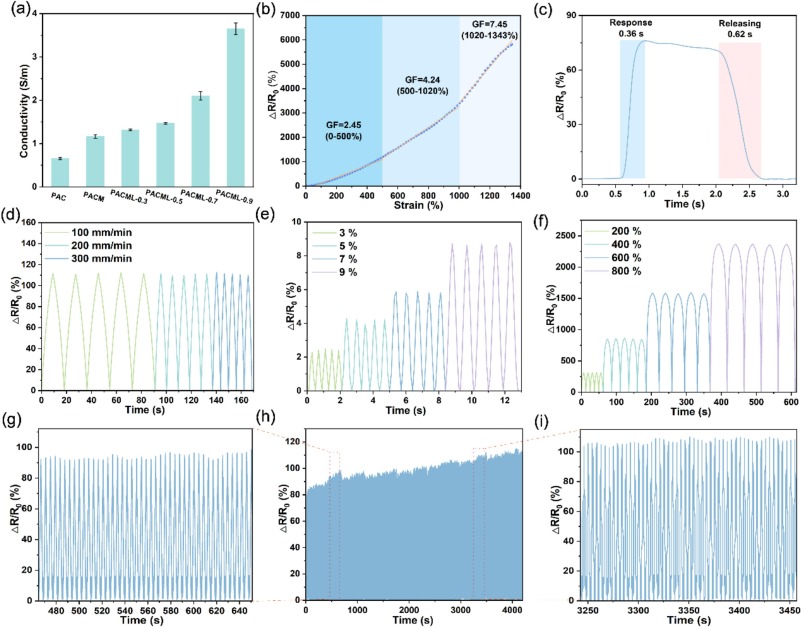
Fig. 4. Strain sensing performance of the PACML-0.9 hydrogel sensor. (a) Electrical conductivity of different hydrogel samples, (b) Gauge factor (GF) and relative resistance change (RRC) of PACML-0.9 over a strain range of 0–1343%, (c) Response and recovery times during a fast stretching–releasing cycle at 50% strain, (d) RRC at different stretching rates under 50% strain, (e) RRC during cyclic stretching–releasing processes at micro-strain (3–9%), (f) RRC during cyclic stretching–releasing processes at large strain (200–800%), (g–i) Long-term stability of the PACML-0.9 hydrogel sensor.
Fig. 4b presents the relative resistance change (ΔR/R₀) of the PACML-0.9 hydrogel strain sensor over a strain range of 0–1400%. The gauge factor (GF) of this sensor exhibited strain dependence, with values of 2.45 in the low-strain region (0–500%), 4.24 in the medium-strain region (500–1000%), and 7.45 in the high-strain region (>1000%). The high sensitivity at low strains enables the detection of subtle physiological signals such as pulse waves, respiration, and small-angle joint flexion, while the enhanced sensitivity at high strains facilitates accurate monitoring of full-range dynamic movements of joints such as knees and elbows. Upon application and rapid release of 50% strain, the sensor displayed a fast response time of 0.36 s and a recovery time of 0.62 s (Fig. 4c), confirming its capability to accurately capture rapid dynamic motions. Under different stretching rates ranging from 100 to 300 mm/min, the sensor exhibited stable resistance responses at 100% strain (Fig. 4d). As shown in Figs. 4e–f, the PACML-0.9 sensor demonstrated consistent resistance responses across multiple strain levels from 3% to 800%. Furthermore, the sensor exhibited excellent long-term stability over 1000 consecutive stretching–recovery cycles at 30% strain (Figs. 4g–i). This stability is attributed to the robust mechanical resilience and recoverability of the PVA/AA double network (incorporating dynamic borate ester bonds and ChCl as a hydrogen-bond acceptor), as well as the multiple hydrogen bonds and coordination interactions formed between MXene, LM, and the polymer chains. A comprehensive comparison of the mechanical and electrical properties of the PACML hydrogel with previously reported flexible sensors is presented in Fig. S5, further confirming the superior comprehensive performance of our designed system. These dynamic non-covalent bonds reversibly dissociate and reform during cyclic deformation, dissipating energy to prevent irreversible damage to the network and effectively restoring conductive pathways upon unloading.
The PACML-0.9 hydrogel was connected to two copper electrodes to form a flexible strain sensor [39], [40], [41]. The sensor was then firmly attached to multiple joint surfaces and body regions of human subjects to monitor physiological activities and joint movements of patients (e.g., those in postoperative rehabilitation or with limited mobility). As shown in Figs. 5a–b, when attached to the face, the sensor could accurately capture subtle motions such as swallowing and frowning. When attached to a finger joint, it clearly distinguished different degrees of finger bending, precisely recording the entire process from 0° to 30°, 60°, and further to 90° (Fig. 5c). Furthermore, the sensor was capable of monitoring patients' respiration patterns; we tested the resistance responses during mouth breathing (Fig. 5b) and nasal breathing, and the signal variations correlated well with breathing frequency and amplitude. For joint motion monitoring, the sensor stably and accurately recorded the movements of the elbow (Fig. 5f), wrist (Fig. 5g), and knee (Fig. 5h) at different bending speeds. Moreover, when closely attached to the throat region, the sensor effectively monitored the vocalization state of patients. Fig. 5i, j, and k present the resistance responses recorded while uttering “Hello”, “OK”, and “Thank you”, respectively, with distinct waveform characteristics for each voice. These results demonstrate that the PACML-0.9 hydrogel sensor serves as a high-performance wearable monitoring platform, covering a comprehensive range of human activities from large-scale limb movements (e.g., joint flexion) to subtle physiological signals (e.g., swallowing, respiration, vocalization). This sensor holds significant application value in personalized health management, postoperative rehabilitation monitoring, human–machine interaction, and soft robotics, especially for patient populations requiring long-term, non-invasive monitoring, thereby offering a new technological approach for telemedicine and intelligent diagnosis.
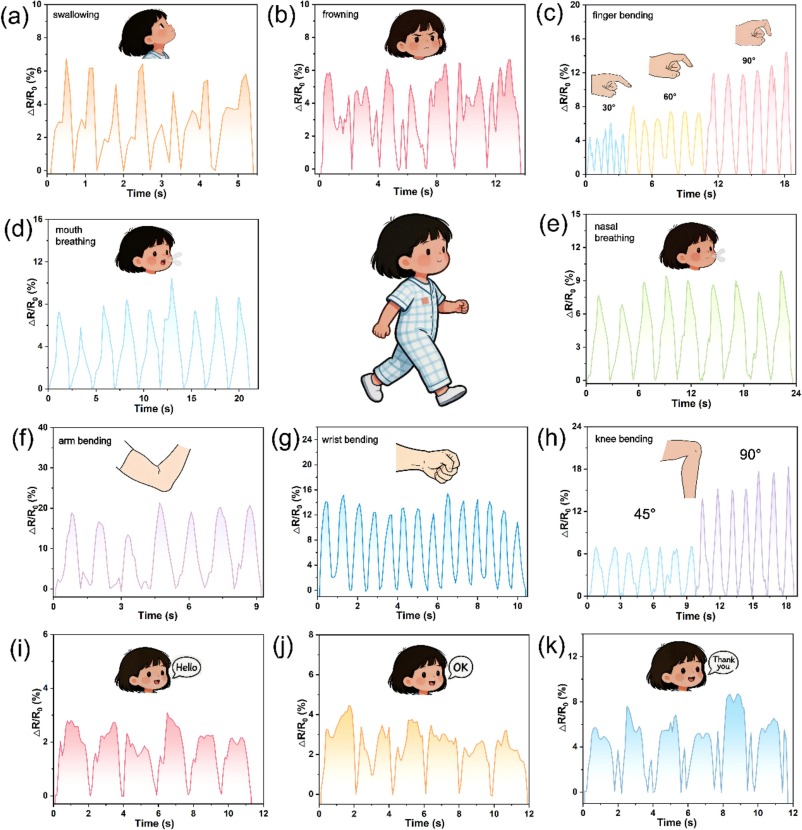
Fig. 5. Real-time monitoring and joint motion recognition of the wearable hydrogel strain sensor. Relative resistance changes during various body activities: (a) Swallowing, (b) Frowning, (c) Finger bending at 30°, 60°, and 90°, (d) Mouth breathing. (e) Nasal breathing, (f) Elbow bending, (g) Wrist bending, (h) Knee bending, (i) Vocalization of “Hello”, (j) Vocalization of “OK”, (k) Vocalization of “Thank you”.
In addition to motion monitoring, signal transmission is equally crucial for practical applications. Given the high sensitivity and excellent mechanical properties of the PACML hydrogel sensor, this study further explored its potential in a wider range of scenarios. As shown in Fig. 6a, the sensor was attached to a tester's finger to monitor strain variations induced by muscle movements during handwriting. When the tester wrote three simple letters, the unique stroke-induced deformation of each letter generated a distinct current response pattern. Upon repeatedly writing the word “YES”, the sensor exhibited an almost constant current pattern, demonstrating its excellent repeatability (Figs. 6b–e). Furthermore, when attached to a finger joint, the sensor enabled real-time collection and analysis of bioelectrical signals generated by finger bending [42]. In Morse code, letters are encoded by combinations of dots and dashes (Fig. 6f). In this study, a short-duration finger bend was defined as a “dot” and a long-duration bend as a “dash”, corresponding to short and long peaks in the resistance signal, respectively. Through continuous and rhythmic finger bending motions, complete words and sentences could be generated; for example, patients with speech or mobility difficulties could send “HELP” to seek assistance from medical staff (Figs. 6g–i). In daily life, short messages such as “yes”, “no”, or even “pain” can also be conveyed. This strategy can be applied to Morse code communication in medical scenarios, thereby effectively improving patient-medical staff interaction (Fig. 6j). In summary, the PACML hydrogel sensor provides a feasible communication tool for patients, not only reducing their dependence on caregivers but also highlighting the great application potential of conductive hydrogels in telemedicine and innovative healthcare services.
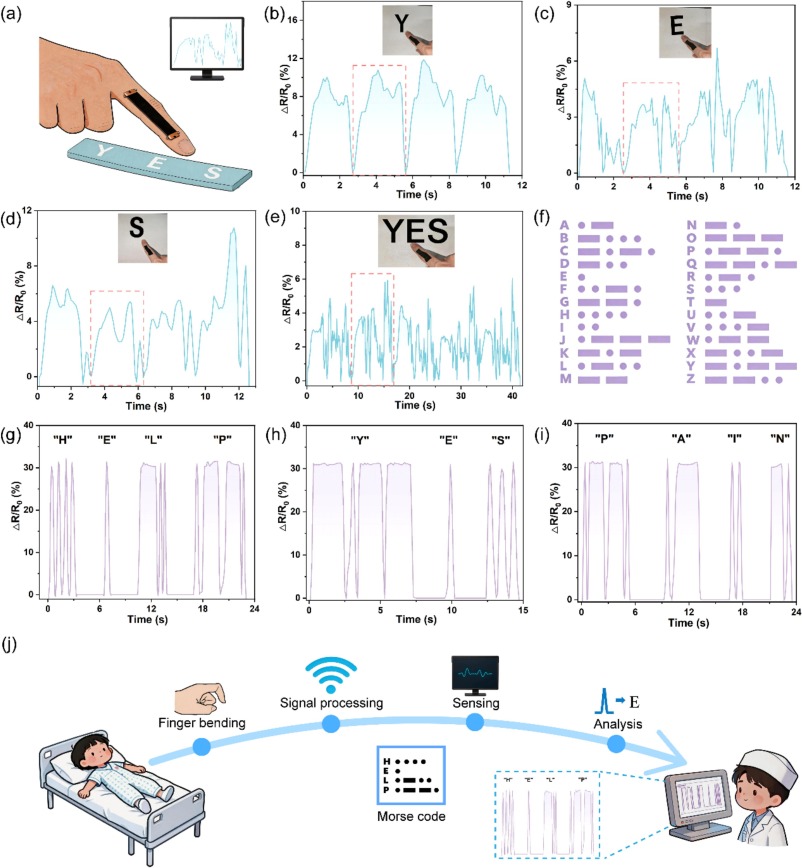
Fig. 6. Information transmission performance of the PACML-0.9 hydrogel sensor. (a) Current changes when the hydrogel is attached to a finger for writing letters, (b) Current change for the letter “Y”, (c) Current change for the letter “E”, (d) Current change for the letter “S”, (e) Current change for the word “YES”, (f) Morse code symbols for the corresponding letters in the alphabet, (g) Current changes induced by Morse code for “HELP”, (h) Current changes for “YES”, (i) Current changes for “PAIN”, (j) Schematic illustration of the application scenario of the Morse code translation system.
In addition to excellent mechanical properties and sensing capabilities, biocompatibility is a critical prerequisite for the practical application of wearable health monitoring sensors. To evaluate the safety of the PACML hydrogel developed in this study upon contact with human tissues, an in vitro cytocompatibility assessment was conducted. The hydrogel was cocultured with human skin fibroblasts for 5 days, followed by live–dead cell staining to evaluate cell morphology and viability. As shown in Fig. 7, the fluorescence images obtained from live–dead cell staining provided an intuitive visualization of the cell health status. After coculture with 100% hydrogel extract for the specified duration, a large number of live cells, stained green by Calcein-AM, were clearly visible in the field of view. Under brightfield microscopy [43], these cells exhibited a typical spindle-shaped morphology and formed densely connected cell sheets. In contrast, only a negligible number of dead cells, stained red by propidium iodide (PI) and appearing as red fluorescent dots, were observed. These results further confirm the excellent cytocompatibility of the hydrogel, demonstrating its ability to support normal cell adhesion and proliferation. These findings strongly suggest that the PACML hydrogel holds significant promise as a long-term wearable skin-contact sensor. Its non-toxic nature and cell-friendly characteristics effectively ensure that no noticeable inflammatory or allergic responses are elicited upon contact with human skin (Fig. S6).
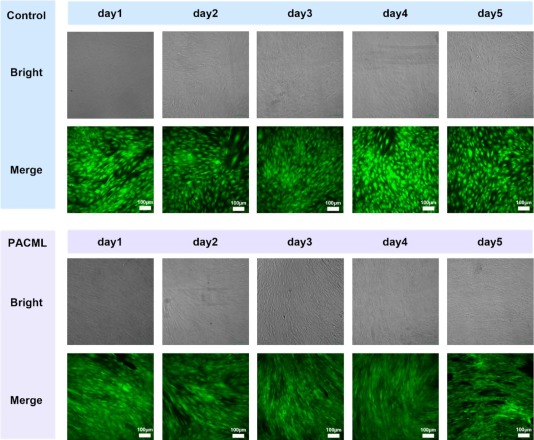
Fig. 7. Representative Live/Dead fluorescence images of human fibroblasts after 5 days of culture with extracts from control and PACML hydrogels.
To evaluate the antibacterial performance of the hydrogels, Gram-negative Escherichia coli (E. coli) and Gram-positive Staphylococcus aureus (S. aureus) were selected as model strains. The antibacterial activities of the hydrogels were assessed using the spread plate method, and the corresponding antibacterial rates are presented in Fig. 8. The PA hydrogel (without MXene, LM, or ChCl) exhibited relatively low antibacterial rates of 20.87% against E. coli and 27.19% against S. aureus, indicating the limited intrinsic antibacterial activity of the pristine PVA/AA double-network matrix. After the incorporation of ChCl and borax (PAC sample), the antibacterial rates increased to 30.02% and 32.46% against E. coli and S. aureus, respectively, suggesting that the ionic components and dynamic borate ester bonds may contribute to moderate bacterial inhibition. Notably, the introduction of MXene@SA (PACM sample) markedly enhanced the antibacterial performance, with antibacterial rates reaching 86.04% against E. coli and 91.89% against S. aureus. This significant improvement is attributed to the sharp-edged structure of MXene nanosheets, which can physically disrupt bacterial cell membranes, and to their abundant surface functional groups, which can induce oxidative stress and membrane damage. Furthermore, the PACML-0.9 hydrogel containing both MXene@SA and LM@LS/HEC exhibited higher antibacterial rates of 90.61% against E. coli and 94.41% against S. aureus, indicating that the synergistic combination of MXene and LM further enhances the bactericidal effect [44]. The PACML samples still maintained highly effective bacterial inactivation, suggesting that the LM droplets stabilized by LS/HEC were well integrated without shielding the active sites of MXene; meanwhile, the coordination interactions between LS and the Ga₂O₃ layer may also contribute to the antibacterial effect through the release of Ga3+ ions. These results confirm that the introduction of MXene and its synergistic interaction with LM are key factors for achieving the outstanding antibacterial activity, and that the PACML hydrogel possesses excellent bactericidal properties, making it a promising candidate for wearable health monitoring applications where infection prevention is critical.
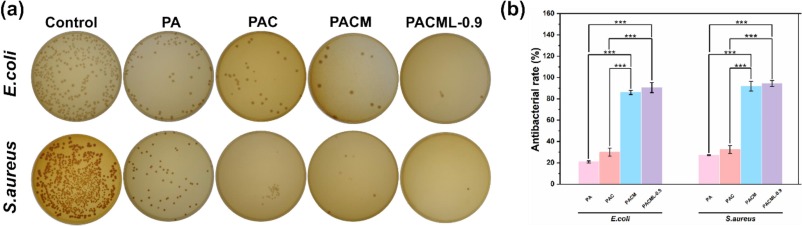
Fig. 8. (a) Representative images of E. coli and S. aureus colonies after treatment with various hydrogels, and (b) the corresponding antibacterial efficiency. Data are presented as mean ± standard deviation. n = 3. *p ≤ 0.05, **p ≤ 0.01, ***p ≤ 0.001.
In this work, we have successfully developed a stretchable, antibacterial, and biocompatible ionic hydrogel (PACML) by incorporating MXene@SA and LM@LS/HEC hybrid fillers into a poly(vinyl alcohol)/acrylic acid double-network matrix, reinforced with dynamic borate ester bonds and choline chloride as a hydrogen-bond acceptor. The use of bio-based dispersants—sodium alginate for MXene and hydroxyethyl cellulose/sodium lignosulfonate for liquid metal—enables uniform filler distribution and establishes a synergistic “point-to-plane” conductive network, which endows the hydrogel with exceptional mechanical properties (tensile strength of 180.8 kPa, elongation at break of 1352%, and toughness of 965.21 kJ/m3), high electrical conductivity (3.65 S/m), and outstanding cyclic durability (83.84% stress retention after 10 cycles at 500% strain). The hydrogel exhibits potent antibacterial activity, achieving a 100% killing rate against E. coli, primarily attributed to the sharp-edged MXene nanosheets and their surface functional groups. Moreover, in vitro cytocompatibility tests confirm excellent cell viability and normal fibroblast morphology, indicating no cytotoxicity and good skin biocompatibility. As a wearable sensor, the PACML hydrogel reliably captures a broad spectrum of human motions—from subtle physiological signals (swallowing, vocalization) to large-scale joint movements—and further enables Morse-code-based communication for patients with speech or motor impairments, thanks to its rapid response (0.36 s) and stable adhesion to various substrates. Collectively, this work offers a versatile and scalable strategy for designing multifunctional hydrogel sensors, holding great promise for postoperative rehabilitation, remote patient monitoring, and intelligent healthcare systems.
Guo Chen: Writing – original draft, Visualization, Data curation. Yuhao Wang: Writing – original draft, Software. Wenli Zhang: Writing – review & editing. Zhaoqing Li: Writing – review & editing. Zifan Lu: Supervision. Hanjie Ji: Investigation, Formal analysis. Zelong Sun: Investigation. Xinlong Dun: Investigation. Lei Zhang: Writing – review & editing, Supervision, Project administration. Di Wei: Writing – review & editing, Supervision, Resources, Project administration, Conceptualization.
来源 查看原文
版权申明 本网站立足国家海洋药物和生物制品产业联盟,致力于打造海洋生物医药“产学研用”一站式、综合性资讯共享服务平台,促进我国海洋药物和功能制品“资源链、科技链、产业链、应用链”协同创新、深度融合发展。本文转载自原文来源。版权归原作者及原来出处所有,部分文章未能联系到原作者,在此深表歉意。如涉及版权问题,请留言联系我们协商处理(邮箱:czhang@tio.org.cn),侵权内容将即刻删除。
免责声明 本文仅代表作者个人观点,与本平台立场无关。本站不对内容真实性、完整性、时效性作保证,仅供参考,请读者自行核实。