
NATIONAL INDUSTRY ALLIANCE FOR MARINE DRUGS AND BIOPRODUCTS
Modern petroleum-based plastics have been widely used as food packaging materials due to their convenience and efficiency (Bai et al., 2024). However, plastic packaging is difficult to be degraded in the environment after being discarded, leading to significant white pollution (Bof et al., 2021). Researchers are committed to exploring biodegradable, sustainable, environmentally friendly, and safe alternatives to plastic (Chaudhary et al., 2022). In addition, high transpiration foods (fruits, mushrooms, vegetables, etc.) have strong respiration and will produce a large amount of water vapor that condenses in the plastic packaging, creating a high-humidity environment for the growth of spoilage microorganisms, thereby accelerating the deterioration of food (Chen et al., 2024). On the contrary, insufficient humidity inside the package can lead to excessive water loss in fresh food, resulting in food shrinkage. Therefore, developing packaging materials that are biodegradable, sustainable, and capable of humidity regulation is of great significance.
Recently, hydrogel films have attracted increasing attention in food packaging systems because of their biodegradability, sustainability, water-retention capacity, and tunable physicochemical properties (J. Ma et al., 2024). Sodium alginate (SA), a natural polysaccharide extracted from marine brown algae (S. Li et al., 2024), is rich in hydroxyl and carboxylic acid functional groups. It exhibits high water absorption and retention properties, low toxicity, and biodegradability, making it an ideal matrix material for hydrogel films (Geng et al., 2024; Liu et al., 2024). However, pure sodium alginate hydrogel films exhibit limitations, including poor mechanical properties, low antibacterial activity, and low strain capacity, which restrict their further applications (An & Zhou, 2024). Using synergistic materials to enhance the performance of substrates while simultaneously imparting multifunctionality is a common approach (Tan et al., 2024). Polyvinyl alcohol (PVA) is a linear, synthetic, water-soluble polymer known for its high reactivity with various types of functional groups, which is frequently employed to improve the physical and mechanical properties of materials (C. Zhao et al., 2024). Despite this, current hydrogel films typically exhibit uniform water vapor permeability on both sides, which hinders effective humidity regulation within the package. Ideally, each side of the food packaging film should possess distinct permeability characteristics. The inner layer prevents water vapor condensation and maintains the desired humidity by absorbing moisture, while the outer layer acts as a barrier to inhibit moisture intrusion from the surrounding environment (Shan et al., 2024). SA/PVA hydrogel films meet the requirements of the inner layer, as their cross-linked network structure can absorb and retain a significant amount of water without dissolving. Therefore, the construction of the outer hydrophobic layer is particularly important. In order to enhance the hydrophobicity of materials for packaging applications, various surface modification techniques have been reported, such as chemical grafting (Lin et al., 2024), sol-gel method (Merghes et al., 2024) and chemical vapor deposition (Lach & Svyetlichnyy, 2024). Among them, chemical vapor deposition of organosilane is a convenient method for regulating the surface wettability of materials.
Cinnamaldehyde (CIN), a chemically active compound found in cinnamon essential oil, is widely used as a natural preservative due to its strong antibacterial and antioxidant properties. However, its high hydrophobicity makes it difficult to apply, and its sensitivity to heat and oxygen may cause deactivation during processing, reducing its effectiveness as a natural preservative. Typically, a well-designed delivery system can be employed to encapsulate and protect essential oils, thereby overcoming this limitation (Q. Zhao et al., 2024). Tannic acid (TA), a naturally occurring polyphenol with high bioactivity and hydrophilicity (Weng et al., 2024), can self-assemble through intermolecular interactions to form a co-delivery nanosystem by combining hydrophobic cinnamaldehyde and hydrophilic tannic acid. Meanwhile, the zinc ionic cross-linking interactions between metal ions and phenolic hydroxyl groups further enhance the stability of the nanosystem, while the metal ions themselves contribute additional antibacterial activity. The development of a stable, well-dispersed, and highly antibacterial multifunctional nanosystem through the synergistic combination of CIN, TA, and zinc offers an excellent nano-modifier for designing high-performance hydrogel film packaging.
Alginate-based hydrogel films have been considered as biodegradable materials for food packaging because they can form continuous films and retain water. However, pure alginate films usually have weak mechanical strength, poor stretchability, limited antibacterial activity, and insufficient water resistance. These problems become more obvious when the films are used for fruits such as strawberries, which are easily affected by water loss, moisture accumulation, microbial decay, and surface browning during storage. Therefore, improving the mechanical stability, antibacterial activity, and moisture regulation of alginate-based films is important for their use in fresh-fruit preservation. In this study, a sodium alginate/polyvinyl alcohol-based hydrogel film was prepared by introducing polyethyleneimine, tannic acid, and cinnamaldehyde/tannic acid/zinc acetate nanoparticles. PVA helped form a stable and flexible hydrogel network through hydrogen bonding and freeze–thaw treatment, while PEI and TA increased the interactions within the polymer matrix. The cinnamaldehyde/tannic acid/zinc acetate nanoparticles (CTZ) were added to improve antibacterial and antioxidant properties. A Janus structure was then formed by one-sided chemical vapor deposition of methyltrichlorosilane, giving the film a hydrophilic inner side and a hydrophobic outer side (Xu et al., 2024). The films were characterized for their structure, optical properties, mechanical behavior, barrier performance, moisture regulation, antioxidant activity, antibacterial activity, and biosafety. Strawberries were used as a perishable fruit model to evaluate the preservation effect of the prepared film during storage (Zhao et al., 2025).
Sodium alginate (type 1799), polyvinylimine, and zinc acetate (99%) were obtained from Aladdin Reagent (Shanghai) Co., Ltd. Cinnamaldehyde, tannic acid, and methyltrichlorosilane were purchased from Shanghai Maclin Biochemical Technology Co., Ltd. Nutrient agar and nutrient broth were purchased from Beijing Road & Bridge Technology Co., Ltd., while Escherichia coli (E. coli) and Staphylococcus aureus (S. aureus) were obtained from Shanghai Luwei Technology Co., Ltd. All reagents used in the experiment were of analytical grade and high purity.
CTZ nanoparticles (CTZ NPs) were prepared following a previously reported method (Sun et al., 2022). Briefly, cinnamaldehyde (CIN, 1 g) was dispersed in anhydrous ethanol (5 mL), and an aqueous tannic acid solution (TA, 1 mg/mL, 250 mL) was added dropwise under magnetic stirring. The mixture was stirred for 30 min and then sonicated for 30 min to obtain a CIN–TA nanoemulsion. Subsequently, zinc acetate (4.39 g) was added dropwise under stirring for 30 min, followed by sonication for an additional 30 min to yield a CTZ nanoparticle suspension. The formation of CTZ NPs is attributed to Zn2+–phenolic coordination, which stabilizes/solidifies the CIN–TA droplets and enhances CIN retention.
A homogeneous SA/PVA/TA solution was prepared by mixing sodium alginate (SA, 2 wt%, 50 mL), poly(vinyl alcohol) (PVA, 8 wt%, 50 mL), and TA (0.6 g) under magnetic stirring at room temperature for 1 h. Polyethyleneimine (PEI, 1%) was then introduced, and the mixture was maintained at 60 °C for 12 h to obtain the film-forming solution. Next, 36 mL of the solution was cast onto a glass plate (12 cm × 12 cm) using a film-casting machine, frozen at −20 °C for 12 h, and then thawed at room temperature to obtain the hydrogel film (SPPT), the film without TA was named SPP. For the CTZ-containing film, CTZ nanoparticles were incorporated into the film-forming solution and mixed uniformly prior to casting, and the resulting film was denoted as SPPT-C.
The surface of SPPT-C was hydrophobically modified by chemical vapor deposition (CVD) to obtain a Janus film (Wang et al., 2024). Briefly, the SPPT-C film was placed in a desiccator, and methyltrichlorosilane (250 μL) was added dropwise. The desiccator was sealed and kept at room temperature for 90 s. The film was then removed and exposed to air for 1 h to eliminate by-product HCl and residual silane. The resulting film was labeled SPPT-CI.
The morphology of the CTZ nanoparticles was examined using scanning electron microscopy (SEM). The particle size distribution was determined by dynamic light scattering (DLS). Fourier transform infrared spectroscopy (FTIR) was employed to analyze the interactions among the components, and X-ray diffraction (XRD) was used to characterize the crystallinity of the materials. The encapsulation efficiencies of cinnamaldehyde and tannic acid were quantified by ultraviolet spectrophotometry. The antibacterial activity was evaluated by determining the minimum inhibitory concentration (MIC) against S. aureus (Gram-positive) and E. coli (Gram-negative) using the broth microdilution method. Detailed experimental procedures are provided in the Supporting Information.
The morphology and microstructure of the hydrogel films were observed by scanning electron microscopy (SEM), while Fourier transform infrared spectroscopy (FTIR) was used to analyze their chemical structure. The UV-blocking properties of the composite film were determined using a UV–Visible absorption spectrophotometer. Surface elemental composition and distribution were characterized via X-ray photoelectron spectroscopy (XPS) and energy-dispersive X-ray spectroscopy (EDS). Mechanical properties were evaluated through tensile testing using a universal material testing machine. Detailed experimental procedures are provided in the Supporting Information.
The antioxidant activity of the hydrogel film was evaluated by measuring its radical scavenging capacity using the DPPH and ABTS assays. The detailed procedures are provided in the Supporting Information.
The oxygen transmission rate (OTR) of the hydrogel membrane was measured using an oxygen adsorption method as described by Liu et al. (2023) with modifications. Briefly, a glass bottle containing 3.0 g of an oxygen scavenger (a mixture of reduced iron powder, sodium chloride, and activated carbon in a 0.5: 1.5: 1 ratio) was sealed with the sample membrane. The assembly was placed in a desiccator with a saturated BaCl2 solution to maintain 90% relative humidity at 25 °C. The OTR was calculated based on the weight gain of the bottle, measured at 24-h intervals, using Eq. (1).(1)where m0 is the initial weight of the glass bottle, mn is the weight of the glass bottle after the nth day, both in g; t is time, in h; and A is the oxygen-permeable area of the specimen film.
The water vapor permeability (WVP) of the hydrogel membrane is measured using the constant weight method (Silva et al., 2024). A circular membrane sample, 2 cm in diameter, is placed tightly over a weighing bottle containing 10 g of anhydrous silica gel. These components are stored in a desiccator conditioned with a saturated NaCl solution (75% RH, 25 °C). The weighing bottle is weighed at regular 1-h intervals over a 12-h period until the weight change is nearly stable. The WVP is measured separately for each side of the membrane, and it is determined according to Eq. (2).(2)WVP = Δm × d Δt × A × ΔPwhere Δm is the weight increment (g); Δt is the measurement interval (s); d is the film thickness (m); A is the weighing bottle opening area (m2); and ΔP is the partial pressure difference (1753.55 Pa) on both sides of the film (25 °C).
The moisture absorption and desorption performance of the films was evaluated using a modified method (Shan et al., 2024b). Square samples (4 cm × 4 cm) were first placed in a sealed desiccator with saturated KNO3 solution (95% RH, 25 °C), hydrophilic side up, and weighed at 24-h intervals until constant weight. They were then transferred to another desiccator with saturated K2CO3 solution (45% RH, 25 °C) and weighed at 4-h intervals until weight stabilized. The absorption and desorption rates were calculated using Eq. (3), (4), respectively.(3)(4)where m0 represents the initial weight of the dry membrane, m1 and m3 represent the membrane weights at 95% RH and 45% RH at a given time, respectively. m2 represents the membrane weight after saturation adsorption at 95% RH.
The biocompatibility of the hydrogel membranes was evaluated through hemolysis testing, cytotoxicity assay (using CCK-8 kit with L929 cells), and a bean sprout growth experiment. The detailed experimental procedures and calculations are provided in the Supporting Information.
The antimicrobial activity of hydrogel membranes was evaluated by the inhibition zone method. Bacterial suspensions (approximately 1.0 × 10⁶ CFU/mL, OD600 = 0.5) in LB medium were mixed with LB agar and poured onto plates with wells. Equal volumes of hydrogel samples were placed into the wells. After incubation at 37 °C for 24 h, the diameter of the inhibition zone (mean of ≥3 replicates per group) was measured to determine antimicrobial efficacy.
Strawberries were selected as the model fruit due to their high postharvest perishability and sensitivity to water loss, microbial decay, surface browning, and fluctuations in the storage microenvironment. These characteristics render strawberries well-suited for assessing the preservation efficacy of the SPPT-CI hydrogel film, which was designed to regulate localized humidity while providing antimicrobial and antioxidant functionalities. Strawberries were purchased from a local market in Nanning. Fruits with similar size, color, and maturity, and without visible mechanical damage, were selected and randomly divided into three groups. Each group contained three strawberries as replicates. The three treatments were as follows: unpackaged control, commercial PE film and SPPT-CI hydrogel film wrapping. The PE film and hydrogel film were cut into pieces of the same size (10 × 10 cm). For the SPPT-CI group, the square hydrogel film was cut at the four corners and then folded toward the center to partially wrap the strawberry. No heat-sealing, adhesive sealing, or closed pouch structure was used. Therefore, the hydrogel film was used as a non-sealed active wrapping film rather than as a complete barrier package. The PE film group was treated in the same non-sealed wrapping manner and used as a commercial film control. All samples were stored at 25 °C. After 9 days, 5 g of strawberry pulp was collected from each group for analysis. Phosphate-buffered saline (PBS) was used as the digestion medium to maintain a stable physiological pH and ionic strength throughout the experiment; this approach minimizes external interference and is consistent with standardized procedures commonly used in food digestion simulations. The pulp was then mixed with 5 mL of sterile PBS, mashed, and vortexed for 2 min. Subsequently, the samples were incubated at 37 °C for 15 min and then centrifuged at 1717.25 g for 4 min. The supernatant was plated onto LBL agar and incubated at 37 °C for 24 h, and colony growth was recorded photographically. Unless stated otherwise, all measurements used the three fruits per group as biological replicates (n = 3).
The titratable acid content of strawberries was determined following a standard method (Shen et al., 2024). Briefly, 5 g of sample was homogenized, diluted with 50 mL deionized water, and allowed to stand for 1 h. After filtration, 20 mL of the filtrate was titrated with 0.1 mol/L NaOH using phenolphthalein as an indicator. Titration continued until a stable pink color persisted for 0.5 min. The content was calculated using Eq. (5).(5)where: V: total volume of sample extraction solution, mL; Vs: volume of filtrate taken for titration, mL; C: concentration of sodium hydroxide titrant, mol/L; V1: volume of sodium hydroxide solution used to titrate the filtrate, mL; V0: volume of sodium hydroxide solution used to titrate distilled water, mL; m: sample mass, g; f: conversion factor (0.067), g/mmol.
The initial weight of the strawberries (W0) was measured after pretreatment, and the weight of the Strawberries (W1) was measured at certain intervals. The weight loss rate was calculated using Eq. (6).(6)where W0 is the initial quality of the Strawberries after pretreatment and W1 is the quality of the Strawberries after storage.
The level of decay is graded according to the degree of decay of the strawberry, with level 0 being no decay and no surface shrinkage, level 1 being <25% decay, level 2 being 25% ≤ decay ≤50%, level 3 being 50% ≤ decay ≤75%, and level 4 being ≥75%. The decay index was calculated using Eq. (7).(7)
The color of the strawberry was recorded using a portable laboratory colorimeter. The total color difference ΔE* was calculated using Eq. (8).(8)△E* = [(△L*)2 + (△ a*)2 + (△b*)2]0.5where the L*, a* and b* values represent the brightness, redness and yellowness of the surface peel of the litchi fruit, respectively.
Unless otherwise stated, all experiments were performed in triplicate (n = 3) using independent samples, and data are expressed as the mean ± standard deviation (SD). Tensile tests were conducted with five specimens per group (n = 5) as described in Section 2.4.7, and MIC tests were performed in triplicate (n = 3) as described in Section 2.3.6. Statistical analysis was performed using one-way analysis of variance (ANOVA), and statistical significance is indicated as follows: *P < 0.05.
First, the formation of CTZ nanoparticles was documented using scanning electron microscopy. As illustrated in (See Fig. 1.) Fig. 2a, the nanoparticles prepared from CTZ exhibit a round and spherical structure, resulting from the ionic cross-linking reaction between tannic acid and zinc acetate. The diameter of the nanoparticles formed by the ionic cross-linking process was 712 nm, as determined by the DLS analyzer (Fig. 2b).
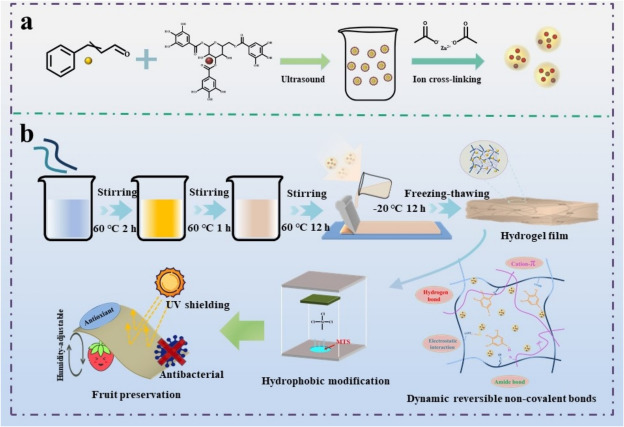
Fig. 1. (a) The schematic diagram of the preparation of CTZ nanoparticles; (b) The schematic diagram of the preparation of SPPT-CI hydrogel film.
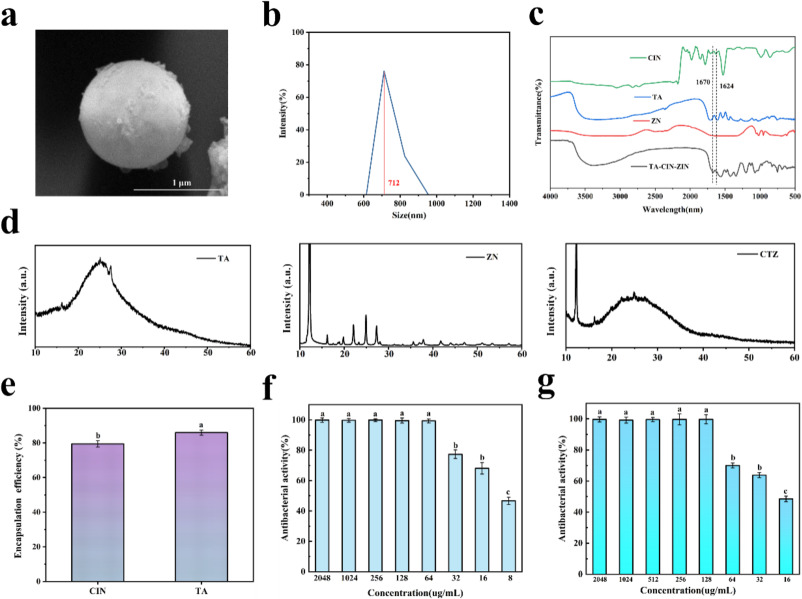
Fig. 2. (a) Microscopic image and (b) particle size of CTZ nanoparticles; (c) FTIR spectra of CIN, TA, ZN and TA-CIN-ZIN; (d) XRD pattern of TA, ZN and CTZ; (e) Encapsulation efficiency of CTZ; Antibacterial activity effects of CTZ against (f) S. aureus and (g) E. coli.
The Fourier infrared spectra of CIN, TA, zinc acetate (ZN) and CTZ are shown Fig. 2c. Cinnamaldehyde exhibits two characteristic peaks at 1624 and 1670 cm−1, which belong to the C C double bond and the CO double bond on the benzene ring, respectively (Liu et al., 2020; Santos et al., 2020). Tannic acid exhibits a broad absorption peak in the range of 3200–3550 cm−1, attributed to the combined effects of the stretching vibrations of the hydroxyl group and the intramolecular hydrogen bonding.
The Fourier-transform infrared (FTIR) of CTZ shows the two characteristic peaks of cinnamaldehyde at 1624 and 1670 cm−1 (W. Yin et al., 2023), indicating the successful incorporation of cinnamaldehyde in CTZ nanoparticles. Zinc ions (Zn2+) form ionic chelates with the phenolic hydroxyl groups (Ar-OH), which facilitates the solidification of CA-TA NEs droplets into CTZ nanoparticles, thereby enhancing the stability of the nanoparticles. Similarly, Chen prepared functionalized microspheres through the oxidative coupling assembly between different metal ions (Cu2+, Zn2+, Fe2+, Ag+) and phenolic hydroxyl groups in green tea polyphenols (H. Chen et al., 2020). Additionally, found that aromatic organic molecular crystals with enhanced π–π stacking interactions can enable ultra-fast storage of Zn2+ (H. Zhang et al., 2020). Therefore, the π-π stacking interactions between aromatic tannic acid molecules also contribute to the storage of Zn2+ in the CTZ system. The characterization of the physicochemical properties of CIN, CTZ, TA, ZN, and CTZ by FTIR spectroscopy confirms that self-assembled spherical nanoparticles were successfully synthesized in this study using zinc metal ions, ionic chelation, and hydrogen bonding between cinnamaldehyde and tannic acid.
Fig. 2d shows the XRD patterns of TA, ZN, and CTZ. Tannic acid exhibits two characteristic diffraction peaks at 14.2° and 24.7° (Niu et al., 2024). Due to its good crystallinity, ZN displays multiple diffraction peaks in the XRD pattern, reflecting its well-ordered crystal structure. Among these diffraction peaks, the maximum diffraction intensity appears at 12.5°, corresponding to the characteristic crystal plane of zinc acetate. Zinc forms a coordinated bond with acetate ions, which promotes the ordered arrangement of zinc ions, ultimately forming a regular crystalline structure. CTZ shows three characteristic diffraction peaks at 11.7°, 19.4°, and 24.1°. CTZ retains the characteristic diffraction peaks of both tannic acid and zinc acetate, indicating that the presence of cinnamaldehyde helps preserve the original crystal structures of both tannic acid and zinc acetate within the system, thereby maintaining their excellent crystallinity and structural stability.
The encapsulation rate is an important indicator for evaluating the quality control of nanoparticles. In order to evaluate the delivery efficacy of CZT nanoparticles for cinnamaldehyde and tannic acid, the encapsulation rates of cinnamaldehyde and tannic acid of both compounds were determined. As shown in the Fig. 2e, the encapsulation rates of cinnamaldehyde and tannic acid reached 79.4% and 85.9%, respectively, which confirmed the efficient loading of these substances within CZT. This further demonstrates the feasibility and effectiveness of constructing integrated nanosystems through self-assembly effects.
The antibacterial activity of CTZ nanoparticles against S. aureus and E. coli was evaluated by the minimum inhibitory concentration (MIC) microdilution method. As shown in Fig. 2f-g, the minimum inhibitory concentrations of CTZ against S. aureus and E. coli were 64 μg/mL and 128 μg/mL, respectively. The prepared CTZ nanoparticles have excellent antibacterial activity. This activity primarily stems from the main antibacterial component of CTZ, cinnamaldehyde, which can interfere with the fluidity of the cell membrane, penetrate the cell membrane and destroy its integrity, ultimately leading to bacterial cell death.
CTZ exhibited a more potent antibacterial effect on S. aureus compared to E. coli, wich can be attributed to the differences in cell membrane structure between E. coli (a gram-negative bacteria) and S. aureus (a gram-positive bacteria) (L. Zhang et al., 2024). Gram-positive bacteria possess a thick layer of peptidoglycan and a cytoplasmic lipid membrane. In contrast, gram-negative bacteria have a three-layer cell wall consisting of an inner cytoplasmic membrane, a thin peptidoglycan middle layer, and an outer lipopolysaccharide layer, which contributes to their relatively low susceptibility to antibacterial agents. The excellent antibacterial activity observed further demonstrates the success of the integrated construction of CTZ nanoparticles.
The microstructure of the hydrogel membranes was characterized using scanning electron microscopy, as shown in Fig. 3. The hydrogel membranes of all components have a porous morphology, which is due to the interaction between the sodium alginate and polyvinyl alcohol molecular chains. However, upon closer inspection, the network structure of the SP and SPP hydrogel membranes is relatively rough, due to the limitation of the interaction force between the molecular chains and the fact that the amidation of SA and PVA molecules cannot be achieved only in the presence of PEI molecules. The introduction of TA increases the number of cross-linking sites within the system, enhancing interactions between molecules, such as hydrogen bonds, coordination bonds, and ionic bonds. This results in a more loosely arranged three-dimensional honeycomb network structure of SPPT. The loose and porous nature of this structure improves the mechanical properties and tensile strength of the hydrogel film. As illustrated in Fig. 3, the addition of CTZ does not compromise the original porous structure of SPPT; the spherical morphology of the CTZ nanoparticles is clearly visible. This observation indicates good compatibility between CTZ and SPPT, confirming the feasibility of preparing SPPT-C hydrogel membranes.
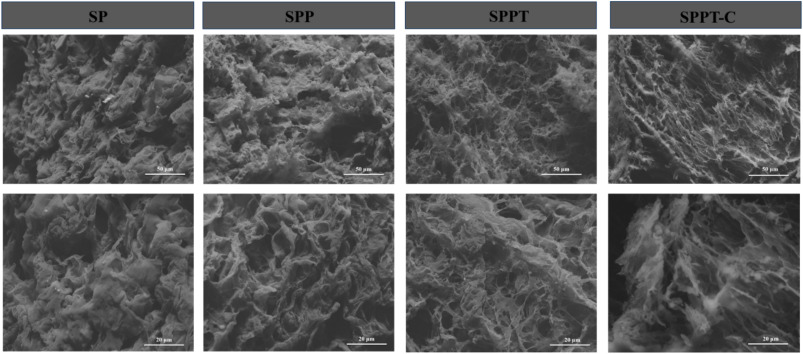
Fig. 3. Low (1600×) and high (3000×) magnification SEM images of the cross-section of SP, SPP, SPPT and SPPT-C hydrogel membranes.
As shown in the Fig. 4a, the spectra of SP, SPP, SPPT, and SPPT-C all show similar absorption peaks: the broad bands in the range of 3600–3000 cm−1 correspond to the stretching vibration of -OH (Qian et al., 2019), and the bands in the range of 2800–3000 cm−1 correspond to the stretching vibration of C H (-CH or -CH2) (Hu et al., 2018). In addition, 1646 cm−1 and 1110 cm−1 correspond to the stretching vibrations of the carboxylate group (-COO-) (Y. Li et al., 2020). 1110 cm−1 is the CO bond of the hydroxyl group of the alcohol (Hu et al., 2018). It is noteworthy that, in contrast to the SP and SPP spectra, a new peak at 1090 cm−1 is observed in the SPPT spectrum, which can be attributed to the amide bond formed between -COOH on SA and -NH2 on PEI (Zhou & Roelfes, 2021). After incorporating CTZ nanoparticles into the hydrogel film matrix, the peak of the hydroxyl group shifted toward a higher wavenumber, which is consistent with the changes in hydrogen bonding induced by the nanoparticles. This indicates the presence of hydrogen bonding interactions between the nanoparticles and the matrix. This result indicates that the amidation reaction between protonated SA and PEI occurs only in the presence of TA, which provides hydrogen ions. Apart from this peak, no peaks related to the newly formed chemical bonds were detected, suggesting a physical interaction with other polymers.
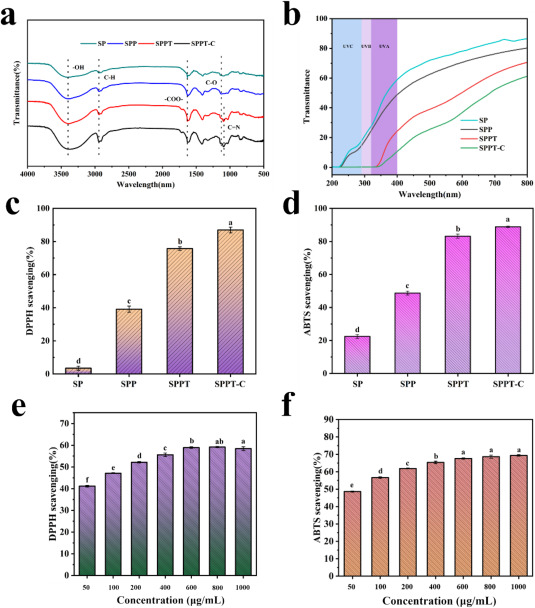
Fig. 4. (a) FTIR spectra of SP, SPPT and SPPT-C films; (b) UV − Vis transmittance spectra; (c) DPPH scavenging activity; (d) ABTS scavenging activity. (e-f) Antioxidant properties of CTZ nanoparticles. (P < 0.05).
Food is susceptible to photo-oxidation during storage due to ultraviolet (UV) light (L. Yuan et al., 2024), and the UV barrier properties of the prepared hydrogel films were characterized. As shown in Fig. 4b, the light transmittance is sensitive to the composition of the film. SP and SPP films showed the highest transmittance in the ultraviolet region, indicating their poor UV blocking performance. However, when TA was doped into the hydrogel film, the transmittance of SPPT and SPPT-C dropped to nearly throughout the ultraviolet region, indicating their excellent UV shielding ability. This improvement is primarily attributed to the aromatic ring structure in TA, which effectively reduces the penetration of ultraviolet light. Additionally, the -NH2 chromophoric group in the PEI enhances the UV shielding ability of the TA. Furthermore, as cross-linking occurs in the hydrogel, the transmittance of the film-forming solution decreases and the color darkens.
Oxidation reactions accelerate quality deterioration during storage (Wan et al., 2024). Therefore, the antioxidant capacity of the films was evaluated using DPPH and ABTS+ radical scavenging assays (Fig. 4c–d). Films containing TA (SPPT and SPPT-C) exhibited high scavenging activities, reaching 86.92% (DPPH) and 88.84% (ABTS+), which is mainly attributed to the abundant phenolic hydroxyl groups of TA that act as effective hydrogen/electron donors. After incorporating CTZ nanoparticles, the antioxidant performance of the film (SPPT-C) increased further, indicating an additional contribution from the CIN/Zn2+-containing CTZ nanoreservoir. Consistently, CTZ nanoparticles alone showed moderate radical scavenging activities (58.447% for DPPH and 69.375% for ABTS; Fig. 4e–f), supporting that the enhanced performance of SPPT-C arises from the synergistic combination of the TA-rich matrix and CTZ additives rather than from the hydrogel network alone.
These results indicate that TA plays a dual role in the hydrogel films. On one hand, its aromatic structure contributes to UV shielding by reducing light transmission in the UV region. On the other hand, its phenolic hydroxyl groups provide hydrogen/electron-donating ability, which improves radical scavenging activity (L. Li et al., 2025). The incorporation of CTZ nanoparticles further strengthened this antioxidant effect, suggesting that the antioxidant performance of SPPT-C was derived from both the TA-rich hydrogel matrix and the active CTZ. For food packaging, this combined UV-shielding and antioxidant ability may help reduce photo-oxidation and oxidative quality deterioration during storage (Kumari et al., 2024).
The surface of the SPPT-CI hydrogel membrane after silanization was observed using SEM. Fig. 5a and b show the surface of the film at different magnifications. A surface coating resembling fish scales can be observed on the surface of the film. Fig. 5c presents the XPS spectrum of the SPPT-CI hydrogel membrane, which indicates the presence of Si 2p (SiO and SiC) and further confirms the silanization of the surface of the hydrogel membrane. The silanized film surface exhibits a Si content of 23.9%, which is consistent with the results of the SEM images. The elemental distribution on the surface of the SPPT-CI hydrogel membrane was further analyzed using EDX, as illustrated in the Figs. 5d. A high amount of Si was detected on the SPPT-CI. In addition, the uniform distribution of Si confirms the presence of a uniform organosilicon coating on the SPPT-CI.
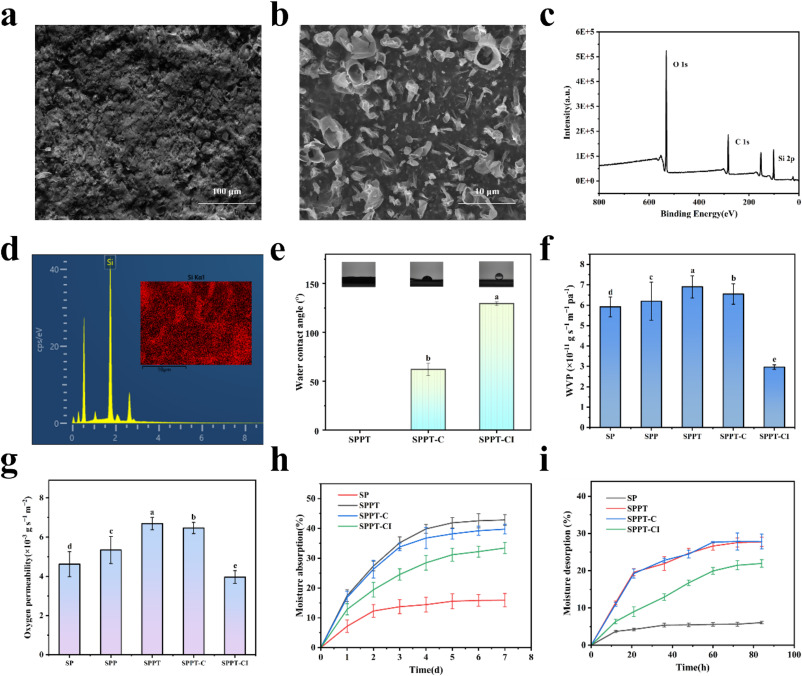
Fig. 5. (a) Low magnification and (b) High magnification of the surface of the organosilane-modified hydrogel membrane; (c) XPS spectra of SPPT-CI; (d) EDX spectra and mapping of SPPT-CI; (e) Water contact angle, (f) Water vapor transmittance (g) Oxygen transmittance, (h) Moisture absorption characteristics at 95% RH, and (j) Demoisturization characteristics at 45% RH of different film samples.
To evaluate the wettability changes during the construction of the final functional hydrogel film, water contact angle (WCA) measurements were performed on three representative samples: SPPT, SPPT-C, and SPPT-CI. SPPT was selected as the pristine hydrogel film matrix before CTZ nanoparticle loading and surface silanization. SPPT-C was used to examine the effect of CTZ nanoparticles on the surface wettability of the hydrogel film, while SPPT-CI was used to verify the formation of the hydrophobic outer surface after one-sided silanization. Therefore, the WCA analysis focused on these key stages of film construction rather than on all intermediate film compositions. As shown in Fig. 5e, the water contact angles of the SPPT, SPPT-C, and SPPT-CI films were measured. SPPT exhibited high wettability and no waterproof properties. SPPT-C, due to the residual CTZ nanoparticles on the surface of the film, showed a water contact angle of 62.1°, indicating some hydrophobicity. After surface modification with silane, SPPT-CI achieved a water contact angle of 129.5°, demonstrating strong hydrophobicity. The successful silanization process imparted high hydrophobicity to the film, resulting in distinctly hydrophobic surfaces on both sides, which potentially facilitates internal humidity regulation.
Water vapor transmission rate and oxygen transmission rate are key factors in evaluating the performance of hydrogel film packaging (S. Yuan et al., 2023). Fruits and vegetables undergo respiration during storage, and maintaining a relatively low oxygen content is beneficial for slowing respiration and reducing physiological metabolism, thereby prolonging freshness. Fig. 5f and g show the water vapor transmission rate and oxygen transmission rate of each component of the hydrogel film. SPP possesses a similar internal structure to SP film and also demonstrates comparable water vapor permeability. The addition of water-soluble tannic acid improves the hydrophilicity of the hydrogel, facilitating the penetration and diffusion of water molecules and thereby reducing the water barrier properties of the SPPT and the gelatinous membrane cross-linking enhances the formation of a more regular network structure, thereby improving the diffusion properties of gases within the pores. As a result, SPPT membranes exhibit a higher oxygen transmission rate compared to SP or SPP membranes. The addition of CTZ did not compromise the original rich network structure; however, due to the presence of TA in the particles, the oxygen permeability of the SPPT-C membrane decreased slightly, though this change was not statistically significant. The modification of the hydrophobic surface of the hydrogel membrane with organosilanes, along with the incorporation of CTZ nanoparticles, reduced the water vapor transmission properties of the film. Additionally, the creation of a hydrophobic surface somewhat limits gas flow properties. In summary, the silane-modified SPPT-CI hydrogel membrane demonstrates excellent water and gas barrier properties, confirming its potential for use as a food packaging material.
During storage, food undergoes transpiration, resulting in an imbalance in humidity within the packaging. A moisture-absorbing and desorbing hydrogel film can effectively regulate the humidity within the packaging, thereby extending the shelf life of fresh food. The moisture-absorbing and desorbing processes of the hydrogel film are divided into two stages: rapid initial moisture absorption/desorption, followed by slower moisture absorption/desorption. TA provides more active hydrophilic groups (carboxyl and hydroxyl groups), facilitating water absorption through hydrogen bonding, thereby enhancing moisture retention in the SPPT hydrogel film. Additionally, TA contributes to the hydrogel film's uniform, continuous, and porous structure, facilitating the penetration of water into the hydrogel. Therefore, both SPPT and SPPT-C exhibit significant moisture absorption capacities of 42.86% and 39.76%, respectively (Fig. 5h).
After seven days of moisture absorption, the samples approach saturation, after which their desorption performance is evaluated by transferring them to a relative humidity of 45%. As shown in Fig. 5i, the initial desorption rate is relatively slow compared to the moisture absorption curve. This may be attributed to the fact that water molecules are tightly bound to the polymer network, making their release difficult. SPPT and SPPT-C still exhibit the highest desorption rates. It is worth noting that SPPT-CI, due to its surface hydrophobicity and internal hydrophilic Janus structure, does not exhibit the highest moisture absorption/desorption capacity. However, it does exhibit effective moisture absorption and slow moisture desorption during the process, demonstrating its excellent performance as a humidity-regulating food packaging material.
The humidity-regulating behavior of SPPT-CI should not be interpreted only by the maximum moisture absorption or desorption value. For fresh-fruit preservation, maintaining a relatively balanced local moisture environment is more important than rapid water uptake alone (Jia et al., 2025). The hydrophilic inner network of SPPT-CI can absorb part of the water vapor generated by strawberry transpiration, while the hydrophobic outer surface slows excessive water exchange with the external environment. This Janus structure may help reduce both fruit dehydration and local moisture accumulation. The former can cause shrinkage and weight loss, whereas the latter can promote microbial growth and tissue deterioration (M. Li et al., 2025). Therefore, the humidity-regulating behavior of SPPT-CI provides an important basis for its strawberry preservation performance.
The mechanical properties of food packaging materials determine their applications and service life. As shown in the stress-strain curve (Fig. 6a), the tensile strength of the original SP film is 192.74 kPa, and its elongation at break is 164.33%. The addition of PEI and TA to the hydrogel film produces various cross-linking effects, which simultaneously increase both tensile stress and strain; tensile strength rises to 316.61 kPa, while elongation at break increases to 455.68%. This improvement in mechanical properties can be attributed to multiple interactions within the hydrogel network. PVA promotes the formation of a flexible network through hydrogen bonding and freeze-thaw-induced crystallization (D. Chen et al., 2025). PEI and TA further increase the interaction density through hydrogen bonding, electrostatic interactions, and the potential formation of amide bonds, thereby simultaneously improving both tensile strength and elongation. The incorporation of CTZ nanoparticles did not weaken the hydrogel network, indicating that these nanoparticles were well integrated into the SPPT matrix. The further improvement in performance following single-sided silanization may be related to additional surface interactions between the organosilane layer and the alginate chains. Overall, SPPT-CI maintains good flexibility while also possessing sufficient mechanical stability to meet the requirements for wrapping, folding, and handling.
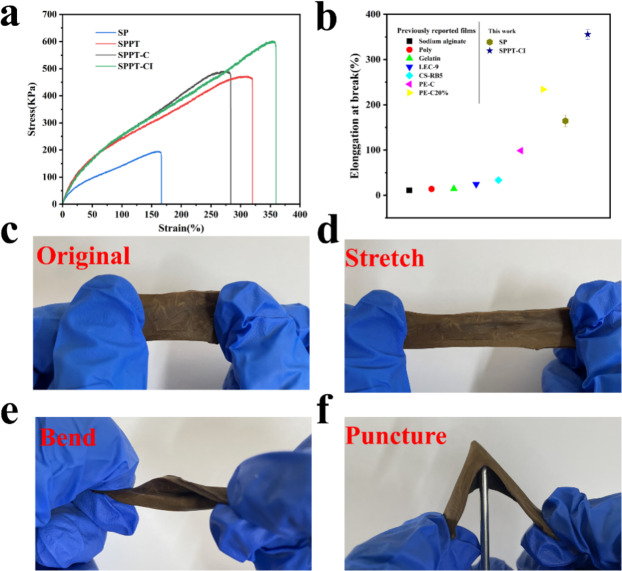
Fig. 6. (a) The stress-strain curves of hydrogel membranes with different compositions; (b) comparison of elongation at break between this work and previously reported films; (c–f) Physical pictures of SPPT-CI hydrogel membranes under stretching, bending, and puncture loads.
The stretchability of the prepared hydrogel film was compared with that of previously reported biopolymer-based food packaging films. As shown in Fig. 6b, the elongation at break of SPPT-CI was higher than those reported for sodium alginate (11%), poly (14%), gelatin (14.5%), LEC-9 (24.32%) (F. Li et al., 2021), CS-RB5 (33.58%) (W. Zhao et al., 2022), PE-C (98.7%)and PE-C/20% (164.3%) (Wen et al., 2022). These results indicate that the SPPT-CI hydrogel film had better stretchability and flexibility than most previously reported biopolymer-based films used for food packaging.
Additionally, the tensile, bending, and puncture resistance properties of the prepared SPPT-CI hydrogel films were also investigated. In summary, all of the aforementioned advantages, including mechanical strength, foldability, stretchability, and puncture resistance, demonstrate the potential of hydrogel films as effective food packaging materials.
Food packaging materials with antimicrobial properties are essential for extending shelf life and ensuring food safety. The antimicrobial activity of the prepared films was evaluated against representative foodborne bacteria (S. aureus and E. coli) using an inhibition-zone assay (Fig. 7a-b). The blank SP film showed no inhibition. In contrast, the TA-containing SPPT film exhibited only small inhibition zones (1.6 mm for S. aureus and 2.5 mm for E. coli), indicating that TA provides a baseline but insufficient antibacterial effect for practical preservation. After introducing CTZ nanoparticles, the inhibition zones increased markedly to 5.4 mm (S. aureus) and 7.9 mm (E. coli) for SPPT-CI, demonstrating the dominant contribution of CTZ to antibacterial performance. This enhancement is consistent with the strong activity of CTZ nanoparticles (MIC: 64 μg/mL for S. aureus and 128 μg/mL for E. coli; Fig. 2f–g). The slightly different rank order between free nanoparticles and composite films can be rationalized by matrix-controlled availability and diffusion of active components, which alters the effective exposure at the film–bacteria interface. The inhibition-zone results also indicate that the active components in SPPT-CI were available at the film–bacteria interface. For active food packaging materials, antimicrobial performance depends not only on the intrinsic activity of the additives, but also on their exposure, diffusion, and interaction with microorganisms on the food surface (X. Ma et al., 2025). The stronger inhibition observed after CTZ nanoparticle loading suggests that the CTZ system improved the practical antibacterial effectiveness of the hydrogel film compared with TA alone.
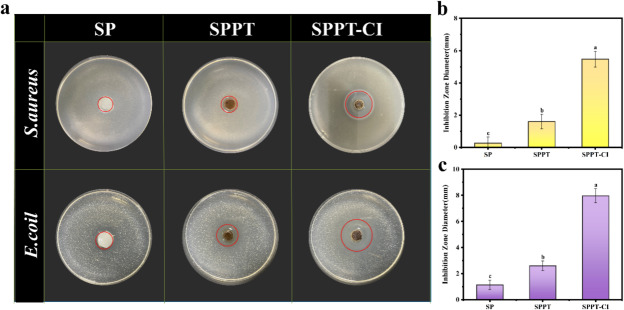
Fig. 7. (a) The bacteriostatic activity of the SPPT-CI hydrogel membrane against S. aureus and E. coli the inhibition zone of sterile water, and the effect of hydrogel membranes with different compositions on the diameter of the bacteriostatic band against (b) S. aureus and (c) E. coli.
Considering the importance of food safety, hydrogel films as food packaging materials should have good biosafety. Blood compatibility is an important indicator for evaluating biosafety. A blood compatibility rate of less than 5% is generally considered indicative of good safety (Song et al., 2022). The materials SP, SPPT, SPPT-C and SPPT-CI all have low hemolysis rates (Fig. 8d), which is beneficial for their application in food packaging.
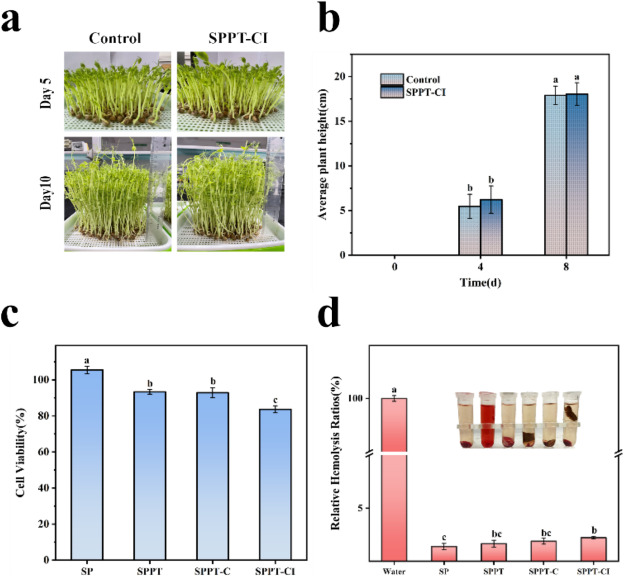
Fig. 8. The growth (a) and mean plant height (b) of sprouts at 0 and 10 d of treatment with water, SPPT-CI membrane liquid; (c) Cell viability and (d) blood compatibility of different films.
As shown in Fig. 8c, the SP, SPPT and SPPT-C hydrogel films have no significant effect on the viability of L929 cells. This is attributed to the excellent biocompatibility of the sodium alginate (SA) and polyvinyl alcohol (PVA) materials, which provide substantial safety benefits when used as template materials. The cell viability of SPPT and SPPT-C reached 93.3% and 92.82%, respectively. The SPPT-CI film maintained a cell viability of 86.61% (Fig. 8b) even after the film surface was silanized, indicating that the SPPT-CI film is a non-cytotoxic and cell-compatible food packaging material. According to the criteria, if the cell survival rate of the treatment group is >80%, the substance is generally considered non-toxic or of low toxicity. This result indicates that the film material does not exhibit significant toxicity to cells at the tested concentration.
In addition, to further investigate the biosafety of the hydrogel membrane, the growth of sprouts cultivated in SPPT-CI solution was monitored. As shown in the Fig. 8a, the sprouts grown in both water and SPPT-CI solution grew well, with no significant change in the length or color. These results suggest that the SPPT-CI film showed good preliminary biosafety under the tested conditions. The high L929 cell viability indicated no obvious cytotoxicity of the film extract, while the low hemolysis rate suggested good blood compatibility. In addition, the normal growth of sprouts treated with the film extract further supported the low biological risk of the prepared film. It should be noted that these assays do not fully replace all safety evaluations required for food-contact materials, but they provide preliminary evidence (C. Yin et al., 2025) supporting the further investigation of SPPT-CI as an active food packaging material.
Strawberries are highly perishable and prone to rapid microbial spoilage and moisture loss; therefore, they were used as a representative high-transpiration model food to evaluate practical packaging performance. Visual images (Fig. 9a) show that discoloration and mold appeared in the unpackaged and PE-film groups from day 3 and progressed over time; by day 9 the unpackaged fruits shrank markedly (> 50%) and PE-packaged fruits showed extensive mold colonies. In contrast, strawberries packaged with SPPT-CI maintained a glossier surface and better shape throughout storage, suggesting that the hydrogel film provides a more balanced microenvironment by combining humidity regulation with antimicrobial protection.
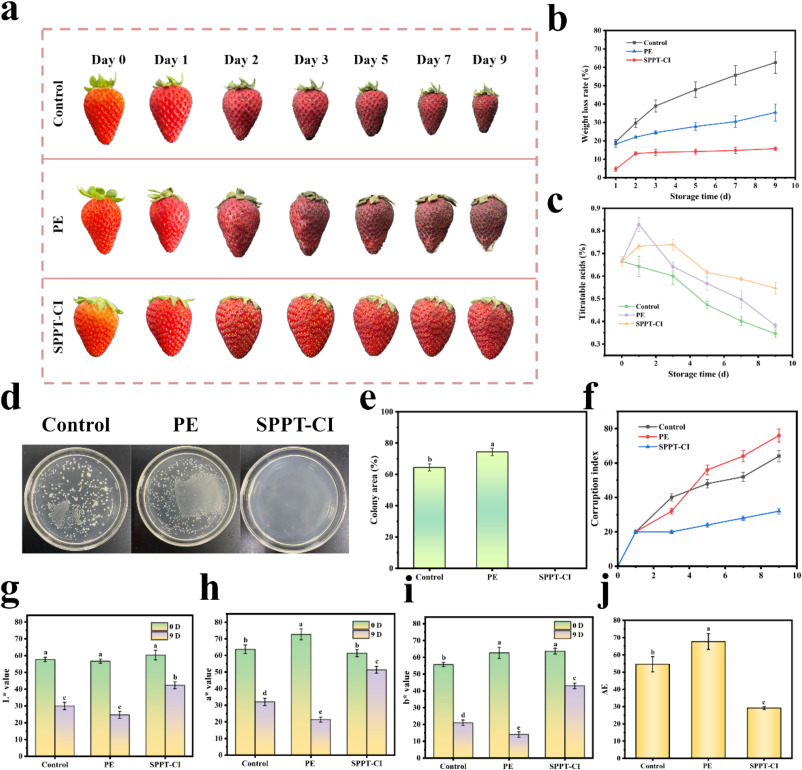
Fig. 9. The application of SPPT-CI hydrogel film in strawberry preservation. (a) Photos of strawberry storage results at different storage times; (b) Dripless acidity, (c) weight loss rate, and (d) plate count diagram after storing strawberries for 9 days; (e) Contamination rate, (f) rot rate, and (g–i) L*, a*, b*, and ΔE values of strawberries during storage.
As shown in Fig. 9b, all strawberries inevitably experience weight loss during storage. Notably, untreated strawberries, which lack any packaging to prevent moisture loss to the air, exhibit the greatest weight loss. When the strawberries are wrapped in polyethylene film, transpiration is somewhat hindered. However, when water vapor escapes, it cannot evaporate and instead accumulates inside the packaging. This accumulation promotes the growth of microorganisms, leading to severe mold formation and a significant decline in quality. In contrast, SPPT-CI hydrogel films, which possess excellent humidity regulation and antibacterial properties, effectively maintain the microenvironment within the packaging. As a result, the strawberries retain their high quality even after long-term storage.
Titratable acidity is an important indicator of fruit freshness during storage because it reflects the consumption of organic acids during ripening and respiration. As shown in Fig. 9c, all groups exhibited an initial increase (peak on day 2) followed by a gradual decrease. After 9 days of storage, the SPPT-CI group retained the highest titratable acidity (0.54%), followed by the PE film group (0.38%) and the unpackaged group (0.34%), indicating better preservation of freshness by SPPT-CI. The sharper decline in the PE film group can be attributed to its high gas-barrier nature that may create a closed microenvironment and promote undesirable anaerobic metabolism at later stages, whereas the humidity-regulating SPPT-CI film mitigates excessive dehydration and moisture condensation, thereby slowing quality degradation.
As shown in the plate images (Fig. 9d), a significant number of bacteria and fungi proliferated from the stems and decaying pulp in both the control and commercial preservation film groups, while no visible colonies were observed in the hydrogel film group. This suggests that the majority of bacteria and fungi were unable to survive on the strawberries. Due to the complexity and density of the colonies, the total colony area was used to quantify the antibacterial efficacy. The colony area of the control and blank film groups exceeded 60% of the total plate area, whereas the colonies in the hydrogel film group were almost invisible. In fact, antimicrobial-active films deactivate microorganisms and create a microenvironment that is unfavorable for microbial growth during subsequent storage. Simultaneously, humidity regulation prevents the formation of a microenvironment conducive to bacterial proliferation.
As illustrated in Fig. 9f, the decay rate of strawberries in both the untreated group and the commercially packaged PE film group reached nearly 100% after 9 days. In contrast, the SPPT-CI hydrogel film group exhibited the lowest decay rate, at only 20%. The lower decay rate in the SPPT-CI group may be related to the non-sealed active wrapping structure of the hydrogel film. Although the film did not form a sealed package, it provided local protection around the strawberry through humidity regulation, partial physical barrier performance, antioxidant activity, and antimicrobial effects from the incorporated CTZ nanoparticles.
The external color of fruits is a key factor influencing consumer acceptance of the product. Fig. 9 (g-j) shows the brightness (L*), redness (a*), greenness (b*), and total color change (E) of strawberries during storage. The L*, a*, and b* values of strawberries in all groups decreased with the prolongation of storage time, which is associated with the darkening of color as the strawberries deteriorate. However, the SPPT-CI group exhibited the least color change, and the strawberries maintained a bright color for a longer period. Both respiration and enzymatic reactions lead to browning in strawberries. Notably, strawberries in the untreated group and PE film group turned browner and darker, while the SPPT-CI film effectively prevented color change and helped maintain strawberry freshness. The freshness-preserving performance of SPPT-CI should be understood as the combined result of humidity regulation, partial oxygen barrier properties, antioxidant activity, and antimicrobial activity. During strawberry storage, excessive moisture loss can lead to fruit shriveling and weight loss, while the accumulation of moisture around the fruit can promote microbial growth and rot (Qin et al., 2025). The double-sided structure of SPPT-CI may absorb some of the water vapor released through strawberry transpiration and slow down excessive moisture exchange with the surrounding environment, thereby helping to maintain a more balanced local humidity environment. Furthermore, oxygen exposure is closely associated with oxidative reactions, color deterioration, and the depletion of organic acids (Tan et al., 2025). Although respiratory rates were not directly measured in this study, the SPPT-CI group exhibited better retention of titratable acidity and less color change, which may be partly attributed to reduced oxidative deterioration and a more favorable storage microenvironment. The antioxidant activity provided by TA and CTZ nanoparticles may help delay browning, while CTZ antimicrobial activity can reduce microbial contamination and spoilage (Khan et al., 2025). Therefore, the preservative effect of SPPT-CI is not determined by a single property but rather by the combined effects of humidity regulation, antioxidant activity, antimicrobial protection, and partial barrier properties. In addition, the dark color and limited transparency of SPPT-CI should be considered for practical packaging applications. The color mainly comes from TA and CTZ nanoparticles, which also contribute to UV shielding, antioxidant activity, and antimicrobial activity. Therefore, SPPT-CI may not be suitable as a fully transparent outer packaging material. A more practical application would be to use it as an active inner liner, humidity-regulating absorbent pad, or non-sealed local wrapping film inside a transparent packaging container. This design would allow consumers to see the strawberries while the film provides moisture regulation, antimicrobial protection, and antioxidant activity.
The present study shows that the SPPT-CI hydrogel film has good potential as a non-sealed active wrapping material for fresh-fruit preservation. Its Janus structure, CTZ nanoparticles, and TA-rich hydrogel network contributed to humidity regulation, antioxidant activity, antibacterial activity, and strawberry quality retention. In this work, strawberries were used as a representative highly perishable fruit, and E. coli and S. aureus were selected as model microorganisms to provide a proof-of-concept evaluation. Further studies may extend this system to other food products and spoilage microorganisms, such as yeasts and molds, under different storage conditions. In addition, the preservation behavior was discussed based on the measured film permeability, water vapor transfer, microbial growth, color change, titratable acidity, and decay rate. Direct measurements of fruit respiration rate and package O₂/CO₂ composition would provide additional information for understanding the relationship between film permeability and fruit metabolism. Since the SPPT-CI film was applied as a non-sealed wrapping film rather than a heat-sealed pouch, future work may also evaluate its sealability and compatibility with commercial packaging processes.
In summary, this study presents a highly stretchable SPPT hydrogel film, prepared through a freeze-thaw process, capable of undergoing tensile deformation of 350% without breaking. Additionally, chemical vapor deposition was used to modify one side of the membrane, creating a hydrophobic surface that regulates moisture. XPS and EDS analyses confirmed that the organosilane was successfully and uniformly attached to the surface of the composite membrane. Furthermore, the incorporation of the antimicrobial agent CTZ endowed the membrane with excellent antimicrobial activity, effectively eliminating S. aureus and E. coli. The final SPPT-CI film exhibits multifunctional properties, including UV-blocking ability, antioxidant activity, antibacterial properties, moisture regulation, and high extensibility. In practical applications, the prepared hydrogel film serves as both food packaging and cling film, significantly extending the shelf life of fresh strawberries. This work facilitates the rapid development of high-performance hydrogel films in the field of food packaging and preservation.
Gang Wu: Writing – original draft, Visualization, Software, Project administration, Methodology, Investigation, Data curation. Wei Su: Writing – review & editing, Supervision, Funding acquisition. Jianhua Wei: Supervision, Resources, Formal analysis. Lini Huo: Software, Methodology, Conceptualization. Haiyi Zhong: Software, Methodology, Conceptualization. Peiyuan Li: Validation, Software.
来源 查看原文
版权申明 本网站立足国家海洋药物和生物制品产业联盟,致力于打造海洋生物医药“产学研用”一站式、综合性资讯共享服务平台,促进我国海洋药物和功能制品“资源链、科技链、产业链、应用链”协同创新、深度融合发展。本文转载自原文来源。版权归原作者及原来出处所有,部分文章未能联系到原作者,在此深表歉意。如涉及版权问题,请留言联系我们协商处理(邮箱:czhang@tio.org.cn),侵权内容将即刻删除。
免责声明 本文仅代表作者个人观点,与本平台立场无关。本站不对内容真实性、完整性、时效性作保证,仅供参考,请读者自行核实。