NATIONAL INDUSTRY ALLIANCE FOR MARINE DRUGS AND BIOPRODUCTS
Sodium alginate enhanced stiffness and ionic conductivity in thermoplastic starch.
Ionic conductivity increased nearly 12-fold with sodium alginate addition.
Thermal healing restored 88.9% of tensile strength in the 9 phr alginate material.
All formulations showed shape recovery of 87.5–93.8%.
Flexible ionic sensors enabled touchscreen input and programmable commands.
The development of sustainable ionic conductors capable of simultaneously achieving high mechanical robustness and efficient ionic transport remains a major challenge because structural reinforcement typically compromises ion mobility. Herein, multifunctional ionic networks were engineered by incorporating sodium alginate (SA) into thermoplastic starch/calcium chloride (TPS/CaCl2) to investigate its influence on structure-property relationships. Rheological, mechanical, and dynamic mechanical analyses supported network reinforcement, interpreted through a proposed supramolecular model involving hydrogen bonding and reversible Ca2+-carboxylate coordination. The elastic modulus increased from 0.22 to 0.38 MPa, while ionic conductivity simultaneously increased nearly twelvefold, from (4.72 ± 0.26) × 10−3 to (5.63 ± 0.24) × 10−2 S cm−1, demonstrating that mechanical reinforcement coexisted with enhanced ionic conduction. All formulations exhibited approximately complete temporary shape fixation (Rf = 100%) and high shape recovery (87.5–93.8%), while the 9 phr SA formulation recovered 88.9% of its tensile strength after thermally assisted healing. The formulation containing 9 phr SA combined high conductivity with favorable mechanical and thermomechanical properties and was successfully employed as a flexible ionic sensor, exhibiting stable electromechanical responses under extension, compression, and bending deformations, a gauge factor of 1.70, compatibility with capacitive touchscreens, and the capability to convert mechanical stimuli into programmable electronic commands. These findings demonstrate that SA incorporation simultaneously strengthens the polymer matrix and enhances conductivity, providing a simple strategy for developing multifunctional polysaccharide-based ionic conductors for wearable electronics and human-machine interfaces.
Thermoplastic starch
;
Calcium chloride
;
Sodium alginate
;
Ionic conductivity
;
Flexible sensor
The rapid development of wearable electronics, electronic skin, soft robotics, and human-machine interfaces has substantially increased the demand for soft conductive materials capable of simultaneously combining mechanical flexibility, structural robustness, and reliable electrical signal transmission [1], [2], [3], [4]. Unlike conventional electronic conductors, ionic conductive polymers transport electrical signals through the migration of ions within hydrated polymer networks, providing excellent deformability, biocompatibility, transparency, and stable electromechanical performance [5], [6]. These characteristics have positioned polymeric ionic conductors among the most promising material platforms for next-generation flexible electronic devices [7], [8], [9]. Despite these advances, simultaneously achieving high mechanical performance and efficient ionic conductivity remains one of the major scientific challenges in polymeric ionic conductors [10], [11]. These properties are intrinsically coupled through the molecular organization of the polymer network. Increasing intermolecular interactions generally reinforces the material by restricting polymer-chain mobility, whereas highly hydrated and loosely organized structures facilitate ionic transport at the expense of mechanical integrity [11], [12]. Consequently, overcoming the conventional trade-off between mechanical robustness and ionic conductivity has become a central objective in the development of multifunctional conductive materials.
Recent advances have shown that the multifunctional performance of ionically conductive polymeric materials is strongly governed by the molecular organization of the polymer network, which simultaneously controls mechanical behavior and ion transport [13]. Among the different molecular design strategies proposed in recent years, supramolecular engineering has emerged as a particularly effective approach because reversible non-covalent interactions, including hydrogen bonding, ionic interactions, and metal-ion coordination, continuously dissociate and reform under external stimuli [14], [15]. Unlike permanent covalent crosslinks, these dynamic interactions allow molecular rearrangement while preserving network integrity, promoting energy dissipation, adaptive deformation, self-healing, and shape-memory behavior [16]. Consequently, tailoring supramolecular interactions has become an effective strategy for simultaneously improving structural integrity and multifunctional performance in sustainable polymeric ionic conductors.
Natural polysaccharides have attracted increasing attention as sustainable building blocks for supramolecular conductive materials owing to their renewability, biodegradability, abundance, and rich chemical functionality [17]. Among them, starch (St) is particularly attractive because of its low cost, ease of processing, and large number of hydroxyl groups available for intermolecular interactions [18], [19], [20]. However, thermoplastic starch (TPS) generally exhibits limited mechanical stability under highly hydrated conditions, restricting its broader application in flexible electronics [21]. Consequently, strategies capable of reinforcing TPS while preserving its ionic conductive behavior remain highly desirable.
Recent studies have explored starch ionic conductive materials containing calcium chloride (CaCl2) for applications including polymer electrolytes, conductive films, wearable sensors, flexible electronics, conductive hydrogels, supercapacitors, and electroosmotic systems [22], [23], [24], [25], [26], [27], [28]. These investigations demonstrate that CaCl2 performs multiple functions within starch-based matrices. Besides supplying mobile ionic species for electrical conduction, CaCl2 promotes starch gelatinization, disrupts the semicrystalline organization of starch granules, suppresses retrogradation, reduces crystallinity, and modifies intermolecular interactions through reversible coordination with hydroxyl groups [26], [27], [28]. Comparative studies involving different chloride salts have further demonstrated that CaCl2 is particularly effective in promoting starch amorphization while maintaining favorable mechanical and conductive properties [22], [23], [24], [29]. Furthermore, glycerol plays an equally important role in these systems by reducing intermolecular hydrogen bonding between starch chains, increasing chain mobility, improving flexibility, and maintaining the hydrated environment required for efficient ionic transport [28], [30]. As a result, St/CaCl2/glycerol formulations have been successfully employed to produce flexible ionic conductors [28]. Although these studies have considerably advanced starch conductive materials, they have primarily focused on improving individual properties, such as ionic conductivity, gelatinization behavior, hydrogel formation, mechanical reinforcement, or sensing performance. However, a central question for further development is how to introduce additional network junctions that improve mechanical integrity without impairing the molecular mobility and hydrated environment required for ionic transport.
Sodium alginate (SA) provides a molecular basis for addressing this question because it combines hydroxyl groups capable of hydrogen bonding with carboxylate groups that coordinate Ca2+ [31], [32], [33], [34], [35], [36], [37]. In a starch matrix, these functionalities offer complementary interaction sites: hydrogen bonding can connect the polysaccharide chains, whereas Ca2+-carboxylate coordination can introduce additional ionic junctions. Previous studies have already established the feasibility of combining starch, SA, and calcium ions. Fernandes et al. [38] prepared alginate/starch hydrogels by immersion in solutions containing CaCl2, MnCl2, or ZnCl2 and investigated how polymer composition and crosslinking conditions affected swelling, water-absorption kinetics, and spectroscopic properties. More recently, Su et al. [39] developed corn starch-SA double-network hydrogels using two calcium-mediated crosslinking routes and demonstrated that the crosslinking method and calcium concentration governed network morphology and mechanical and rheological behavior. These studies establish important precedents for calcium-mediated network formation in starch/alginate systems.
Based on these considerations, the present work examines the incorporation of SA into TPS/CaCl2 to introduce Ca2+-carboxylate junctions alongside hydrogen bonding between polysaccharide chains. The resulting materials are prepared by gelatinization, drying, and compression molding. We investigate how SA content influences network organization and the balance between mechanical reinforcement, ionic conductivity, and stimulus-responsive behavior. Accordingly, this study varies SA content from 0 to 9 phr while keeping the amounts of starch, glycerol, CaCl2, and added water constant, and relates the resulting changes in molecular interactions and network organization to rheological, mechanical, thermomechanical, and electrical properties. Self-healing, shape-memory behavior, and electromechanical sensing are also evaluated. The contribution of this work lies in establishing composition-structure-property relationships for TPS/CaCl2/SA ionic conductors, with particular emphasis on the simultaneous evolution of mechanical stiffness and ionic conductivity and on their integration with functional responses relevant to flexible sensors.
Commercial food-grade corn starch (St; Maizena®, Unilever Brasil Ltda., Brazil), derived from Zea mays, was used as the starch source. This commercial starch has been reported to contain approximately 29.7 wt% amylose [40]. Glycerol (Gly, purity ≥99.5%; Neon, São Paulo, Brazil) was used as a plasticizer, while calcium chloride dihydrate (CaCl2·2H2O, purity >99%; ACS Científica, São Paulo, Brazil) was used as the ionic salt. Sodium alginate (SA; Dinâmica Química, São Paulo, Brazil), with a Mw of approximately 112.5 kDa, was used as a secondary polysaccharide to modify the thermoplastic starch matrix. Distilled water was used as the solvent throughout sample preparation. All materials were used as received without further purification.
TPS/CaCl2/SA materials were prepared according to the compositions summarized in Table 1. The amounts of starch (St), glycerol (Gly), distilled water, and CaCl2.2H2O were kept constant in all formulations, while the sodium alginate (SA) content was varied from 0 to 9 phr relative to the St mass.
Table 1. Composition of the TPS/CaCl2/SA formulations.
| Sample | St (g) | Gly (g) | CaCl2.2H2O (g) | Water (g) | SA (phra) | SA (g) |
|---|---|---|---|---|---|---|
| 0 SA | 32 | 8 | 32 | 20 | 0 | 0 |
| 3 SA | 32 | 8 | 32 | 20 | 3 | 0.96 |
| 6 SA | 32 | 8 | 32 | 20 | 6 | 1.92 |
| 9 SA | 32 | 8 | 32 | 20 | 9 | 2.88 |
phr = parts per hundred parts of St by mass.
Initially, 32 g of St and 8 g of Gly were manually premixed in a beaker until a homogeneous mixture was obtained. Separately, 32 g of CaCl2.2H2O was dissolved in 20 g of distilled water at 80 °C under magnetic stirring. The resulting CaCl2 solution was then added to the St/Gly mixture, and the suspension was mechanically stirred at 600 rpm and 80 °C for 5 min to promote starch gelatinization and homogenization. For the SA-containing formulations, the required amount of SA was gradually added at the beginning of this mixing step and dispersed throughout the suspension under the same processing conditions.
After mixing, the resulting materials were placed in a desiccator containing silica gel for 3 days to promote moisture removal, followed by oven drying at 80 °C for 4 h. The dried materials were subsequently compression-molded at 125 °C using a hydraulic press. The molding cycle consisted of 3 min of preheating/pre-pressing followed by 5 min of compression under a load of 6 tons. After compression molding, all specimens were conditioned at 25 °C and approximately 55% relative humidity (RH) for 7 days prior to characterization and testing. Following conditioning, water content was determined by weighing specimens before and after drying in a vacuum oven at 80 °C to constant mass and expressing the mass loss as a percentage of the conditioned specimen mass.
Fourier-transform infrared (FTIR) spectra were recorded using a Bruker ALPHA II spectrometer equipped with an attenuated total reflectance (ATR) accessory over the wavenumber range of 400–4000 cm−1. Oscillatory rheological measurements were performed using an Anton Paar Physica MCR 702e rheometer equipped with a parallel-plate geometry (25 mm diameter and 1 mm gap). Frequency sweeps were conducted at 100 °C, over an angular frequency range of 0.1–628 rad s−1 using a strain amplitude of 2%, within the linear viscoelastic region. Tensile properties were determined using an Oswaldo Filizola AME universal testing machine. Compression-molded specimens were prepared according to the Type V geometry specified in ASTM D638 and tested at room temperature at a crosshead speed of 50 mm min−1. Five specimens were tested for each formulation. Dynamic mechanical analysis (DMA) was performed using an Anton Paar Physica MCR 702e rheometer. Rectangular specimens (56 × 13 × 3 mm3) were analyzed from −40 to 65 °C at a heating rate of 5 °C min−1 and a frequency of 1 Hz. The self-healing capability was evaluated by completely cutting the specimens into two separate pieces and subsequently bringing the cut surfaces into direct contact without applying pressure. Localized heating was applied for 1 min using a heat gun positioned 15 cm from the specimens, reaching a maximum temperature of 96.5 °C. After healing, the specimens were subjected to mechanical testing to evaluate the healing efficiency. Shape-memory behavior was evaluated using rectangular specimens (25 × 13 × 3 mm3). The specimens were initially heated at 60 °C for 5 min and subsequently manually stretched to approximately 60% strain to define the temporary shape. While maintaining the imposed deformation, the specimens were cooled at room temperature for 5 min to fix the temporary shape. The constraint was then released, and the fixed dimensions were recorded. Shape recovery was triggered by reheating the specimens at 60 °C, and dimensional changes were monitored until no further significant variation in length was observed. The shape-fixity ratio (Rf) and shape-recovery ratio (Rr) were calculated from the initial (L0), deformed (Ld), fixed (Lf), and recovered (Lr) specimen lengths according to Eqs. (1), (2), respectively.(1)(2)
Electrical measurements were evaluated using a collinear four-point probe configuration connected to a Keysight B2900A Source Measure Unit. The measurements were performed using a Signatone SP4-50045TRS probe assembly, consisting of four equally spaced, spring-loaded tungsten carbide tips arranged in a linear configuration, with a nominal spacing of 1.27 mm between adjacent probes and a tip radius of 41 μm. Each probe tip applied a nominal contact force of 45 gf (approximately 0.44 N) [41], [42]. The film specimens had lateral dimensions of 50 × 50 mm2 and a thickness of approximately 1.0 mm. All measurements were performed at the center of the film surface to minimize edge effects [43]. During the measurements, electrical current was applied through the two outer probes, while the corresponding voltage drop was measured between the two inner probes. Electrical resistance was obtained from the measured voltage and applied current. The electrical resistivity (ρ) was calculated using the conventional four-point-probe expression for thin specimens, according to Eq. (3) [43]:(3)where ρ is the electrical resistivity, t is the specimen thickness (m), V is the measured voltage (V), and I is the applied current (A). The ionic conductivity (σ) was subsequently calculated as the reciprocal of resistivity according to Eq. (4):(4)
Electromechanical sensing performance was evaluated using a data-acquisition system coupled to a voltage-divider circuit for real-time monitoring of resistance changes under mechanical deformation. Specimens (56 × 13 × 3 mm3) were subjected to tensile deformation while their electrical resistance was continuously recorded. Sensor sensitivity was expressed as the gauge factor (GF), calculated from the relative resistance change (ΔR/R₀) as a function of applied strain (ε) according to Eq. (5). Additional sensing experiments were performed under manual stretching, cyclic compression, and bending, with the electrical responses continuously recorded as ΔR/R₀.(5)
Functional human-machine interaction was further demonstrated by converting mechanically generated electrical pulses into digital commands. Short- and long-duration stimuli were assigned to the dot and dash signals of Morse code, respectively, enabling real-time character recognition. Different touch patterns were also programmed to trigger electronic outputs, including LED activation and audible signals. Finally, the ability of the material to interact directly with a commercial capacitive touchscreen was qualitatively evaluated by using the sensor as the conductive input element.
The FTIR spectra of the individual components and the TPS/CaCl2/SA formulations containing 0, 3, 6, and 9 phr of SA are presented in Fig. 1. The starch spectrum exhibits a broad band in the approximately 3000–3600 cm−1 region, associated with O H stretching, and weaker absorptions around 2930 cm−1 corresponding to CH stretching. The characteristic carbohydrate vibrations near 1100, 1000, and 980 cm−1 involve C-O-C and CO stretching within the polysaccharide structure [38]. Glycerol exhibits a broad OH stretching band, weaker CH stretching absorptions around 2900 cm−1, and pronounced CO stretching contributions in the approximately 1000 cm−1 region. These overlap with starch vibrations in the St/Gly spectrum, limiting the identification of separate contributions from the two components. The hydrated CaCl2 reference exhibits water-related OH stretching absorptions and features at 1625 and 1609 cm−1, tentatively associated with H-O-H bending in its hydration environment.
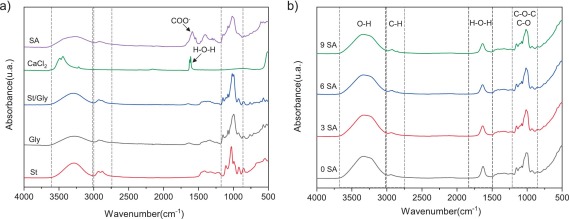
Fig. 1. FTIR spectra of (a) starch (St), glycerol (Gly), the St/Gly mixture, hydrated CaCl2, and sodium alginate (SA); and (b) TPS/CaCl2/SA formulations containing 0, 3, 6, and 9 phr of SA.
A marked change in spectral profile is observed when the St/Gly reference is compared with the formulation containing CaCl2 without alginate (0 SA). The most evident differences include the appearance of a distinct band near 1631 cm−1 and changes in the resolution of the fingerprint region absorptions. These differences are consistent with changes in the local environment of the oxygen-containing groups and water during salt incorporation. Ca2+ may interact with oxygen donor sites in starch and glycerol, while hydration of the dissolved ions and redistribution of hydrogen bonds can modify the overlapping vibrational contributions. Liu et al. [26] likewise reported substantial spectral changes in St/CaCl2 materials and interpreted them in terms of starch-Ca2+ interactions. However, the present comparison does not independently separate the effects of salt addition and hydration, nor does it establish a particular coordination site.
The band at approximately 1631 cm−1 is most plausibly dominated by the H-O-H bending vibration of water within the hydrated polymer/salt matrix. Its occurrence in 0 SA demonstrates that SA is not required for its formation. The difference relative to the hydrated salt reference may reflect redistribution of water among ionic and hydroxyl-containing environments, producing overlapping contributions that appear as a single band [44]. In contrast to the marked difference between St/Gly and the St/Gly/CaCl2 compositions, increasing SA content from 0 to 9 phr produces no clearly resolved systematic spectral changes at the scale presented. A plausible explanation is the relatively low alginate loading, at most nine parts per hundred parts of starch by mass, combined with extensive overlap between its hydroxyl, carboxylate, and carbohydrate vibrations and those of the hydrated matrix. Similarity between spectra does not necessarily exclude intermolecular interactions: Li et al. [27] reported similar FTIR profiles for native starch and starch regenerated from chloride salt solutions despite structural differences detected using complementary methods. Accordingly, the present FTIR results reveal a pronounced difference after salt incorporation but do not independently resolve SA's additional molecular contribution. Hydrogen bonding and Ca2+-carboxylate coordination remain plausible contributions to the proposed network and should be considered alongside complementary results [31], [32].
Oscillatory frequency sweep measurements were performed to investigate the influence of SA on the viscoelastic behavior of the TPS/CaCl₂ matrix (Fig. 2). The storage modulus (G′) and loss modulus (G″), Fig. 2a and b, exhibited similar behavior for all formulations, increasing continuously with angular frequency, as expected for viscoelastic polymeric systems in which molecular relaxation becomes progressively restricted at shorter deformation timescales. Throughout the investigated frequency range, G′ remained higher than G″, indicating the predominance of elastic over viscous behavior [45], [46], [47]. More importantly, increasing the SA content produced a systematic increase in both G′ and G″, with the 9 phr formulation exhibiting the highest values over almost the entire frequency range. This behavior indicates that SA promotes the formation of additional reversible junctions within the TPS/CaCl₂ matrix, increasing the density of transient supramolecular crosslinking points. These junctions are likely established through cooperative hydrogen bonding between starch and alginate chains together with ionic coordination between Ca2+ ions and alginate carboxylate groups, generating localized egg-box structures embedded in the thermoplastic starch matrix, thereby progressively restricting polymer chain mobility.
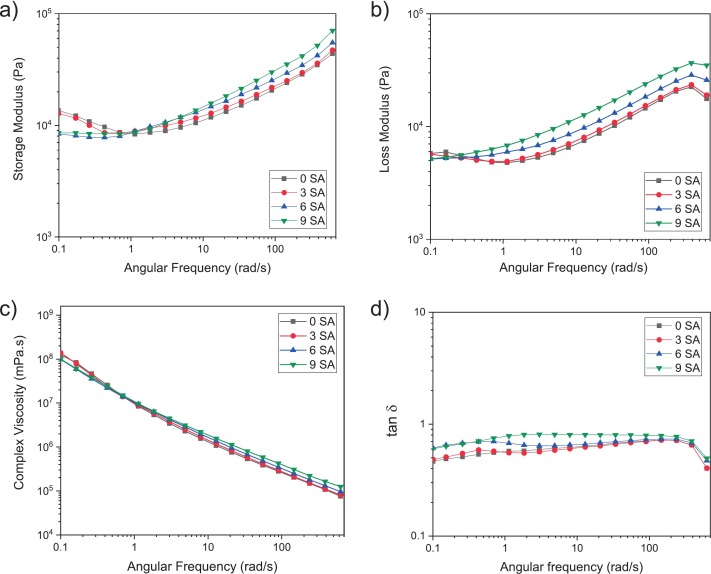
Fig. 2. Frequency-dependent rheological behavior of TPS/CaCl2/SA formulations containing different SA contents (0, 3, 6, and 9 phr): (a) storage modulus (G′), (b) loss modulus (G″), (c) complex viscosity (η*), and (d) damping factor (tan δ).
The complex viscosity (η*) (Fig. 2c) decreased continuously with increasing angular frequency for all formulations, demonstrating typical shear-thinning (pseudoplastic) behavior [48], [49], [50]. This response indicates that polymer chains progressively align while the supramolecular network continuously reorganizes under increasing deformation rates, reducing flow resistance while maintaining network connectivity. The preservation of pseudoplastic behavior further demonstrates that these supramolecular junctions remain dynamic, allowing the network to partially rearrange under shear. Such behavior is particularly advantageous for polymer processing, since the material combines high structural integrity under static conditions with sufficient flowability during extrusion or compression molding. The damping factor (tan δ = G″/G′) (Fig. 2d) remained below unity throughout the investigated frequency range for all formulations, confirming the predominance of elastic over viscous behavior. Despite the substantial increase in both G′ and G″ with increasing SA content, tan δ varied only slightly, indicating that the elastic and viscous contributions increased almost proportionally, thereby preserving the viscoelastic balance of the material. Consequently, the network becomes mechanically stronger without becoming excessively rigid, retaining its ability to dissipate mechanical energy through reversible molecular rearrangements. Such a balanced viscoelastic response is characteristic of dynamic supramolecular networks and is particularly desirable for flexible sensing materials subjected to repeated mechanical deformation.
Similar rheological behavior was reported by Yang et al. [51] for rice starch/sodium alginate systems, in which increasing alginate concentration simultaneously increased G′ and G″ owing to enhanced intermolecular interactions between starch and alginate chains. In the present TPS/CaCl₂ system, the additional presence of Ca2+ ions is expected to further strengthen these interactions through reversible coordination with alginate carboxylate groups, promoting supramolecular ionic junctions that reinforce the polymer network while preserving its dynamic character. These observations are consistent with the role of SA as a supramolecular ionic network former in the TPS/CaCl₂ matrix.
The mechanical properties of the TPS/CaCl2/SA formulations were evaluated by tensile testing, and the corresponding stress-strain curves and obtained values are presented in Fig. 3 and Table 2, respectively. The incorporation of SA progressively modified the mechanical response of the TPS/CaCl2 matrix, leading to a continuous increase in elastic modulus from 0.22 to 0.38 MPa as the SA content increased from 0 to 9 phr. Simultaneously, the tensile strength increased from 0.15 to 0.19 MPa for the formulation containing 6 phr SA, followed by a slight decrease at 9 phr. Conversely, the tensile strain decreased from 151.6% to 88.7%, revealing the typical trade-off associated with the progressive development of the supramolecular network [52], [53].
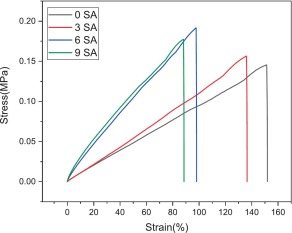
Fig. 3. Representative tensile stress-strain curves of TPS/CaCl2/SA formulations containing different SA contents (0, 3, 6, and 9 phr).
Table 2. Tensile mechanical properties of TPS/CaCl2/SA formulations containing different SA contents (0, 3, 6, and 9 phr).
| Sample | Young's modulus (MPa) | Tensile strength (MPa) | Elongation at break (%) |
|---|---|---|---|
| 0 SA | 0.22 ± 0.03 | 0.15 ± 0.02 | 151.63 ± 18.50 |
| 3 SA | 0.25 ± 0.04 | 0.16 ± 0.02 | 135.14 ± 16.30 |
| 6 SA | 0.38 ± 0.02 | 0.19 ± 0.01 | 98.70 ± 15.20 |
| 9 SA | 0.38 ± 0.01 | 0.18 ± 0.03 | 88.74 ± 9.70 |
The progressive increase in elastic modulus demonstrates that SA effectively reinforces the TPS/CaCl2 matrix, corroborating the rheological results discussed previously. This reinforcement originates from the formation of reversible intermolecular interactions involving hydrogen bonding between starch and alginate chains together with ionic coordination between Ca2+ ions and alginate carboxylate groups. These dynamic supramolecular junctions progressively restrict polymer chain mobility, increasing the resistance of the network to deformation while maintaining its physically crosslinked nature [34]. The tensile strength reached a maximum at 6 phr SA, suggesting an optimum degree of supramolecular reinforcement. Up to this concentration, the increasing number of reversible intermolecular interactions improves stress transfer throughout the polymer network, resulting in higher mechanical resistance. Above this level, however, additional supramolecular junctions appear to contribute primarily to increasing stiffness rather than further enhancing tensile strength, indicating that the reinforcing mechanism approaches saturation. The slight reduction in tensile strength observed for the 9 phr formulation suggests that, beyond an optimum SA concentration, the increased density of supramolecular crosslinking may promote localized network heterogeneities that reduce the efficiency of stress redistribution during deformation [54].
The progressive reduction in strain at maximum stress further supports the development of a more constrained supramolecular network. As the density of supramolecular ionic junctions increases, additional hydrogen bonds together with Ca2+-mediated egg-box junctions progressively restrict conformational rearrangement of the starch chains. In addition to reinforcing the polymer network, the structuring effect of alginate partially counterbalances the plasticizing action of glycerol and CaCl₂, resulting in a gradual reduction in extensibility as the supramolecular ionic network becomes denser. Nevertheless, even the formulation containing 9 phr SA maintained an elongation above 80%, demonstrating that the material preserves substantial deformability despite the pronounced increase in stiffness. Such high extensibility is particularly advantageous for flexible strain sensors, as it enables the material to withstand large and repeated deformations while maintaining structural integrity. Similar mechanical trends have been reported for starch/alginate systems, where increasing alginate content enhances stiffness while reducing elongation owing to stronger intermolecular interactions between the two polysaccharides [55], [56].In the present TPS/CaCl2 system, the presence of Ca2+ ions provides an additional reinforcing mechanism through reversible coordination with SA, generating supramolecular ionic junctions that further stabilize the polymer network. Overall, these results demonstrate that SA acts not simply as a reinforcing additive, but as a supramolecular ionic network former capable of simultaneously increasing structural integrity while preserving sufficient flexibility and molecular mobility.
DMA analysis further confirms the progressive development of the supramolecular ionic network promoted by SA (Fig. 4). As shown in Fig. 4a, the storage modulus (E′), which reflects the elastic component of the material, increased systematically with increasing SA content over the entire temperature range investigated, with the 9 phr formulation exhibiting the highest values, followed by the 6, 3, and 0 phr samples. This behavior is fully consistent with the previous results, demonstrating that the hydrogen-bonding interactions and Ca2+-mediated ionic coordination proposed above effectively reinforce the TPS/CaCl2 matrix. As expected for viscoelastic polymeric systems, both the storage and loss moduli gradually decreased with increasing temperature owing to the progressive enhancement of segmental chain mobility. Nevertheless, all formulations containing alginate maintained higher E′ and E″ values than the neat TPS/CaCl2 matrix throughout the analyzed temperature range, indicating that the supramolecular network remains effective. The simultaneous increase in the loss modulus (Fig. 4b) further indicates that the reinforced network possesses a greater capacity to dissipate mechanical energy during cyclic deformation. Rather than reflecting irreversible structural damage, this behavior is attributed to the continuous rupture and reformation of reversible hydrogen bonds and Ca2+-mediated egg-box junctions, which are characteristic features of dynamic supramolecular polymer networks.
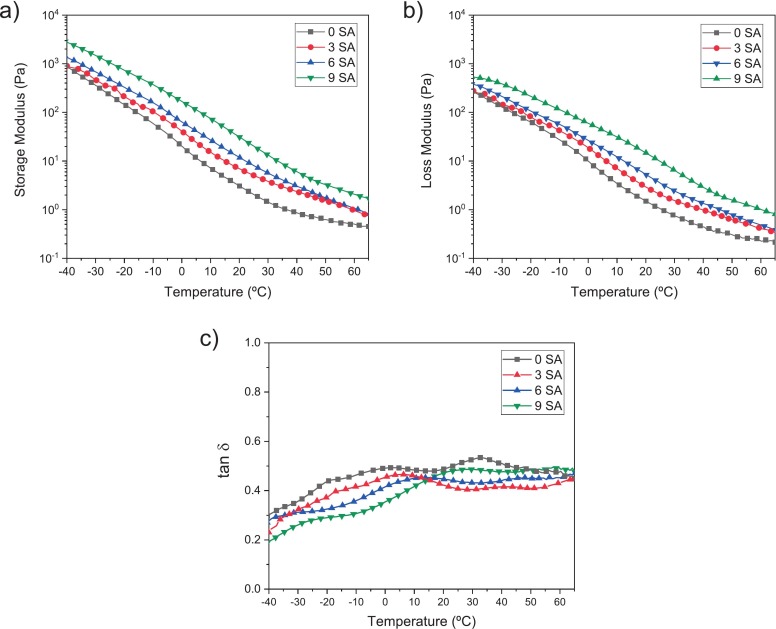
Fig. 4. Dynamic mechanical behavior of TPS/CaCl2/SA formulations containing different SA contents (0, 3, 6, and 9 phr): (a) storage modulus (E′), (b) loss modulus (E″), and (c) damping factor (tan δ).
The damping factor (tan δ) remained below unity over the entire temperature range for all formulations (Fig. 4c), confirming that the elastic component predominates over the viscous response. At lower temperatures, the decrease in tan δ with increasing SA content reflects the increasing restriction of molecular mobility as the density of supramolecular ionic junctions increases. Furthermore, the absence of a sharp and well-defined tan δ peak suggests a broad molecular relaxation process, which is consistent with the heterogeneous molecular environment of highly plasticized TPS systems, where the relaxation of starch chains, glycerol, alginate, and reversible ionic interactions overlaps over a wide temperature interval. As temperature increases, the convergence of tan δ values indicates that the enhanced segmental mobility partially offsets the reinforcing effect of alginate while the reversible supramolecular interactions preserve the overall viscoelastic balance of the material. A similar trend has been reported in the literature [57] where CaCl2-crosslinked SA films retained higher storage and loss moduli during heating than uncrosslinked films owing to the restriction of molecular motion. Although their system did not contain TPS, these findings support that the presence of SA improves the thermomechanical stability of TPS/CaCl2.
Fig. 5 illustrates the thermally induced self-healing of the 9 SA specimen and compares its tensile behavior before and after healing. Following complete cutting, the exposed surfaces were brought into contact without applying pressure and heated for 1 min using a heat gun positioned 15 cm from the specimen. Thermal imaging recorded a maximum temperature of 96.5 °C during treatment. The photographs show the reconnection of the separated pieces, although a visible mark remained at the healed interface. Mechanical testing subsequently confirmed that the rejoined specimen could sustain tensile loading and substantial deformation. As summarized in Table 3, Young's modulus decreased from 0.38 ± 0.01 to 0.35 ± 0.03 MPa after healing, while tensile strength decreased from 0.18 ± 0.03 to 0.16 ± 0.02 MPa and elongation at break from 88.74 ± 10.75% to 84.08 ± 8.18%. Calculated as the ratio between the healed and original mean values, the corresponding recoveries were 92.1%, 88.9%, and 94.7%, respectively. The similar stress-strain profiles further indicate substantial restoration of the tensile response. Recovery therefore extended beyond interfacial adhesion, encompassing stiffness, load-bearing capacity, and extensibility.
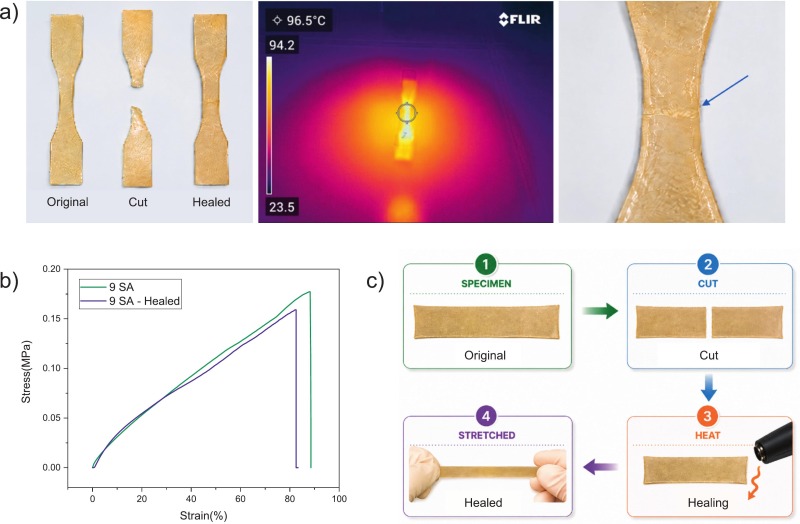
Fig. 5. Thermally induced self-healing of the 9 SA formulation: (a) images of the original, cut, and healed specimens; infrared image recorded during heating, showing a maximum temperature of 96.5 °C; close-up of the healed interface (arrow); (b) tensile stress-strain curves before and after healing; and (c) schematic illustration of the healing procedure.
Table 3. Young's modulus, tensile strength, and elongation at break of the 9 SA formulation before and after thermally induced self-healing.
| Sample | Young's modulus (MPa) | Tensile strength (MPa) | Elongation at break (%) |
|---|---|---|---|
| 9 SA | 0.38 ± 0.01 | 0.18 ± 0.03 | 88.74 ± 9.70 |
| 9 SA - healed | 0.35 ± 0.03 | 0.16 ± 0.02 | 84.08 ± 8.18 |
This substantial mechanical recovery is consistent with the proposed dynamic character of the TPS/CaCl2/SA network. Thermal activation can increase segmental mobility and facilitate molecular rearrangement at the contacting surfaces, allowing hydrogen bonds and Ca2+–carboxylate coordination to re-establish intermolecular connectivity across the interface. These interactions provide a plausible explanation for the recovered mechanical integrity, although the tensile results alone do not establish their individual contributions. A related thermally activated healing mechanism involving reversible Ca2+-mediated interactions has been reported for St/CaCl2 systems [26]. Together, the visual observations and tensile measurements support efficient, thermally assisted healing of the 9 SA formulation under the conditions investigated.
Shape memory systems require a network containing sufficiently stable net points that define the permanent shape, together with a reversible switching mechanism that fixes and releases the temporary shape in response to a stimulus [58], [59], [60]. In the TPS/CaCl2 matrix, starch-chain entanglements, persistent hydrogen-bonded associations, residual organized domains, and interactions between Ca2+ and starch hydroxyl groups probably act as physical net points. The incorporation of SA further reinforces this network through starch-alginate hydrogen bonding and Ca2+-carboxylate coordination. These junctions preserve network connectivity, whereas the polymer chains located between them store elastic conformational energy when stretched at 60 °C. The switching mechanism is the thermally controlled segmental mobility of the plasticized TPS phase. At 60 °C, glycerol, CaCl2, and absorbed moisture provide sufficient chain mobility for deformation. Upon cooling, the decrease in mobility kinetically locks the temporary shape. During reheating, these temporary constraints are relaxed, allowing the stretched chains to return toward higher-entropy conformations, while the persistent physical net points guide recovery toward the initial geometry. Thus, shape recovery is driven by the release of elastic energy stored in the deformed chain segments [61], [62].
The shape memory behavior of the TPS/CaCl2/SA formulations is summarized in Table 4. All compositions exhibited a shape fixation ratio (Rf) of approximately 100%, demonstrating that the deformation imposed at the programming temperature of 60 °C was retained after cooling. Moreover, all formulations displayed high shape recovery ratios (Rr), ranging from 87.5% to 93.8%. Although the 3 phr SA formulation showed the lowest value, recovery progressively improved at 6 and 9 phr, with the latter reaching 93.8%. The recovery time also decreased from 10 min 08 s for TPS/CaCl2 to approximately 7 min for the 9 phr formulation. These results suggest that higher SA contents improve the connectivity of the physical network, reducing irreversible chain slippage and allowing restoring stresses to be transmitted more efficiently once the switching phase regains mobility. This interpretation is consistent with the DMA results in Fig. 5, where SA increased the storage modulus and therefore the capacity of the network to sustain elastic deformation, while the decrease in the moduli with increasing temperature indicates progressive activation of segmental mobility. Comparable recovery was reported by Wang et al. [63] for calcium alginate films, which exhibited an Rf of 72.2% and an Rr of 92.3%. Overall, the results support a thermally activated shape memory mechanism governed by persistent physical net points, elastic deformation of the intervening polymer chains, and reversible temperature-dependent mobility of the plasticized TPS phase.
Table 4. Shape memory performance of TPS/CaCl₂/SA formulations containing different sodium alginate contents (0, 3, 6, and 9 phr), including shape fixation ratio (Rf), recovery time, and shape recovery ratio (Rr).
| Sample | Fixation ratio (%) | Recovery ratio (%) | Recovery time (min) |
|---|---|---|---|
| 0 SA | 100 | 92.9 | 10:08 |
| 3 SA | 100 | 87.5 | 8:02 |
| 6 SA | 100 | 88.9 | 7:01 |
| 9 SA | 100 | 93.8 | 7:00 |
The electrical properties of the TPS/CaCl2/SA formulations are summarized in Table 5. A progressive decrease in electrical resistance and resistivity was observed with increasing SA content, accompanied by a nearly 12-fold increase in ionic conductivity, from 4.72 × 10⁻³ to 5.63 × 10⁻² S cm−1. These results demonstrate that SA substantially enhances ionic transport throughout the TPS/CaCl2 matrix. In hydrophilic polymer electrolytes, electrical conduction occurs predominantly through ion migration instead of electronic transport. Consequently, conductivity depends not only on the concentration of dissociated ions but also on the architecture of the hydrated polymer network, the continuity of ion-transport pathways, water retention, and segmental polymer mobility [6], [33]. This concept is consistent with recent studies on conductive hydrogels, which emphasize that efficient ionic conductors require an optimized balance between ionic content and dynamic polymer architecture rather than simply increasing salt concentration [5], [7], [8]. The relevance of hydration and environmental stability to hydrogel-based sensing is also discussed in the review by Qi et al. [64]. Following conditioning at 25 °C and approximately 55% RH for 7 days, the determined water contents were 11.73 ± 3.7%, 13.86 ± 5.4%, 14.58 ± 4.0%, and 16.08 ± 2.8% for 0, 3, 6, and 9 SA, respectively. Thus, identical conditioning conditions did not yield identical mean water contents. The increase in water content is consistent with changes in matrix hydration associated with hydroxyl and carboxylate groups of SA. Additional water may facilitate ion solvation and polymer segmental mobility, contributing to the conductivity enhancement.
Table 5. Electrical properties of TPS/CaCl2/SA formulations containing different SA contents (0, 3, 6, and 9 phr), including resistivity and ionic conductivity.
| Sample | Resistivity (Ω·cm) | Conductivity (S cm−1) |
|---|---|---|
| 0 SA | 212.02 ± 11.73 | (4.72 ± 0.26) × 10−3 |
| 3SA | 103.37 ± 3.86 | (9.67 ± 0.36) × 10−3 |
| 6 SA | 44.35 ± 0.42 | (2.255 ± 0.021) × 10−2 |
| 9 SA | 17.76 ± 0.75 | (5.631 ± 0.237) × 10−2 |
The conductivity enhancement observed in the present system may therefore involve coupled changes in hydration, ionic composition, and network organization induced by SA addition. Alongside its contribution to hydration and the introduction of sodium counterions, SA can modify intermolecular associations through reversible Ca2+-carboxylate coordination and hydrogen bonding [31], [32]. Within the proposed hydrated supramolecular domains, the fixed carboxylate groups of SA may influence the ionic environment, while the mobile ions (Na+, Ca2+, and Cl−) migrate through the hydrated matrix, assisted by absorbed water and polymer segmental motion. This interpretation is consistent with the polyelectrolyte-assisted ionic conduction reported for conductive hydrogels, in which the polymer network actively facilitates ion transport instead of serving merely as an inert supporting matrix [65]. An important finding is that the conductivity increase occurred simultaneously with the improvements in rheological behavior, tensile properties, thermomechanical stability, and shape memory performance. These results demonstrate that mechanical reinforcement coexists with enhanced ionic conduction in the investigated formulations. Such simultaneous optimization of mechanical robustness and ionic conductivity represents one of the major challenges in conductive hydrogel design and has recently been recognized as a key requirement for flexible ionic electronics and wearable sensors [10], [11].
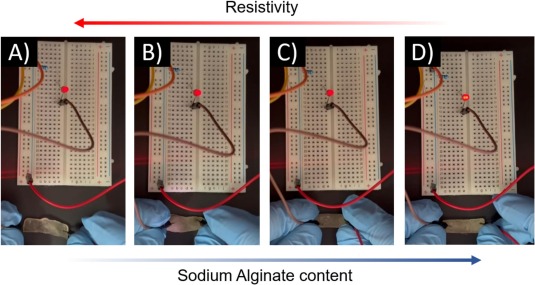
Fig. 6. Qualitative demonstration of the electrical response of TPS/CaCl2/SA formulations containing 0, 3, 6, and 9 phr of SA, shown in panels A, B, C, and D, respectively, using an LED circuit. The progressive increase in LED brightness reflects the reduction in electrical resistance with increasing SA content.
The qualitative LED demonstration (Fig. 6 and Video S1, Video S2) further corroborates the quantitative electrical measurements, showing progressively higher light intensity with increasing SA content, consistent with the reduction in electrical resistance. Notably, Video S1, Video S2 also provide qualitative evidence of electrical self-healing. After the conductive specimen was completely cut, the electrical circuit was interrupted and the LED turned off. When the cut surfaces were subsequently brought back into contact at room temperature the LED was reactivated, indicating rapid restoration of electrical continuity across the damaged interface. Overall, SA incorporation improves both mechanical performance and ionic conductivity in the TPS/CaCl2 system, with the electrical response reflecting the combined influence of hydration and supramolecular organization.
Based on the experimental observations discussed and established descriptions of starch-salt interactions and calcium-mediated alginate association [26], [31], [32], [33], [39], a conceptual supramolecular ionic network model is proposed for the TPS/CaCl2/SA system, as schematically illustrated in Fig. 7. The measured changes in rheological, mechanical, thermomechanical, and electrical properties, together with the healing and shape-memory responses, motivate this interpretation but do not directly establish the molecular arrangement depicted. SA is hypothesized to modify the internal architecture of the plasticized TPS matrix through the establishment of multiple reversible intermolecular interactions. The proposed associations include starch-starch hydrogen bonding, starch-alginate hydrogen bonding, Ca2+-mediated coordination with alginate carboxylate groups, and ion–dipole interactions involving starch hydroxyl groups, while glycerol and absorbed water plasticize the TPS matrix [26], [31], [32], [33].
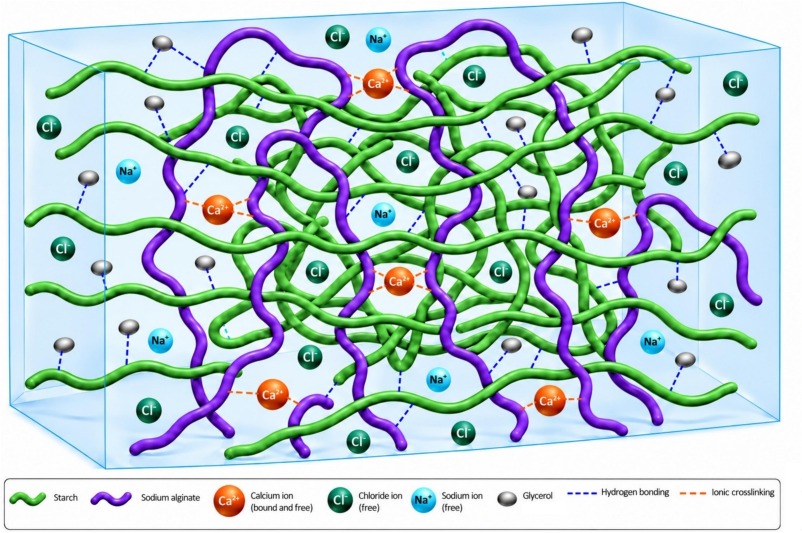
Fig. 7. Proposed conceptual multifunctional supramolecular ionic network mechanism of the TPS/CaCl2/SA system. The schematic illustrates the continuous St matrix reinforced by dispersed SA chains through starch-starch hydrogen bonding, starch-alginate hydrogen bonding, Ca2+-carboxylate ionic coordination (egg-box-like junctions), and Ca2+–hydroxyl ion-dipole interactions with starch chains. Glycerol and absorbed water plasticize the St phase, while mobile Na+, Ca2+, and Cl− ions migrate through hydrated domains, enabling ionic conduction.
Within this proposed architecture, the starch matrix constitutes the continuous structural phase, whereas SA is dispersed as a minor but highly functional component. The carboxylate groups of alginate can coordinate Ca2+ ions to generate localized egg-box-like junctions [32], [33], which act together with persistent hydrogen-bonded associations and chain entanglements as physical net points. These supramolecular junctions may increase network connectivity without introducing permanent covalent crosslinks, consistent with the higher storage and tensile moduli and improved thermomechanical performance. However, the maximum tensile strength at 6 phr SA, followed by a slight decrease at 9 phr, indicates that additional reinforcement does not produce a proportional improvement in all mechanical properties. At higher temperatures, the plasticized TPS phase acquires sufficient segmental mobility to enable molecular rearrangement, whereas sufficiently persistent physical net points can maintain network connectivity over the shape-memory cycle [58], [59]. Thermal mobility can also facilitate interfacial rearrangement during healing, allowing reversible associations to re-form across contacting surfaces [16], [26]. SA is therefore proposed to reinforce an existing physical network, consistent with the shape-memory response also observed in the formulation without SA.
The proposed network also provides a framework for interpreting the electrical response of the material. Ca2+-carboxylate coordination may coexist with mobile ionic species, including Na+, Ca2+, and Cl−, within the hydrated polymer matrix, although their individual mobilities and coordinated fractions were not determined. Together with glycerol and absorbed water, these ionic species support charge transport through the plasticized matrix. The higher mean water contents measured after conditioning for the SA-containing formulations indicate that hydration must also be considered when interpreting the conductivity enhancement [64]. Consequently, SA may contribute both to supramolecular reinforcement and to changes in the hydrated ionic environment. This interpretation is consistent with the broader importance of balancing network mechanics and hydrated ion transport in conductive polymer systems [10], [11], [64]. Overall, the proposed supramolecular ionic network offers a literature-supported interpretation of the multifunctional behavior observed experimentally, rather than a uniquely established molecular mechanism. The schematic brings together plausible contributions from reversible associations, physical net points, hydration, and ionic transport.
The resistance-strain responses of all formulations were evaluated to examine the relationship between SA content and strain sensitivity. The relative resistance (ΔR/R₀) increased approximately linearly with tensile strain, yielding coefficients of determination above 0.98 for all compositions. The corresponding gauge factors were 4.27, 3.37, 2.26, and 1.70 over 0–20% strain for 0 SA, 3 SA, 6 SA, and 9 SA, respectively. Thus, increasing SA content enhanced conductivity but progressively reduced strain sensitivity, demonstrating that these properties do not necessarily follow the same trend. This behavior suggests that SA incorporation modifies both charge transport in the undeformed material and its response to deformation. In ionic hydrogel sensors, resistance changes reflect variations in specimen geometry and may also involve changes in ion mobility and the hydrated transport environment. Furthermore, high conductivity alone does not imply high strain sensitivity [66]. The GF of 1.70 obtained for 9 SA (Fig. 8a) is comparable to values reported for other starch-containing ionic hydrogel sensors. Zhou et al. [67] reported the same GF of 1.70 over 0–100% strain for a double-network starch/PVA/NaCl hydrogel and demonstrated its application in human-motion monitoring. Li et al. [68] reported a GF of 1.99 for a starch-containing semi-interpenetrating hydrogel with an approximately 500% working strain range. Lu et al. [69] obtained GFs of 0.87, 0.95, and 0.50 over strain intervals of 0–40%, 40–80%, and 80–110%, respectively, for a starch/PVA/cellulose-nanocrystal hydrogel crosslinked with borax. These examples indicate that moderate GF values can support motion-sensing applications, although performance also depends on signal repeatability, operating range, and measurement conditions. The importance of the strain interval is further illustrated by Liu et al. [70].
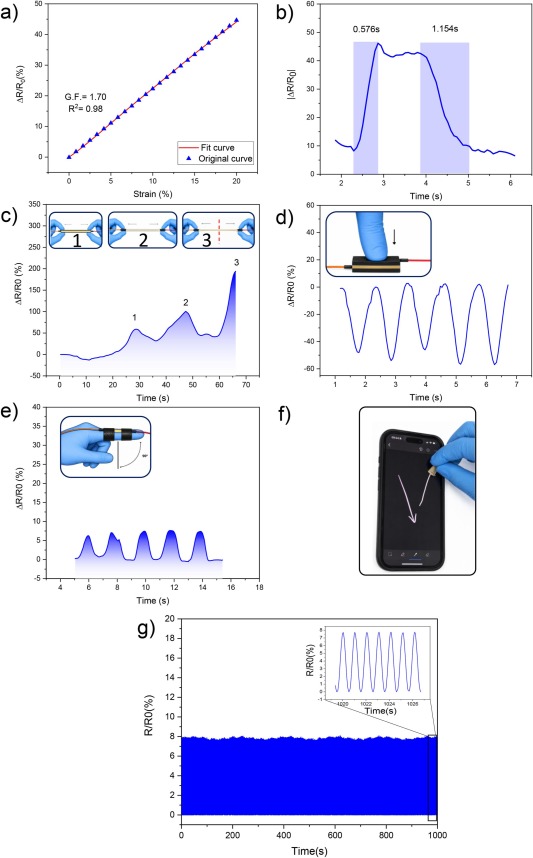
Fig. 8. Electromechanical sensing performance of the TPS/CaCl2/SA formulation containing 9 phr of SA under different mechanical stimuli: (a) relative resistance variation as a function of tensile strain and corresponding gauge factor (GF); (b) response and recovery times under cyclic loading-unloading; (c) relative resistance response under increasing tensile deformation; (d) cyclic compression sensing performance; (e) cyclic bending sensing performance; (f) demonstration of human-machine interaction using a commercial capacitive touchscreen; and (g) electrical response during extended cyclic loading, with an enlarged segment showing individual loading-unloading cycles.
Based on the combined results, the formulation containing 9 phr of SA was selected for further flexible sensing evaluation because it combined the highest ionic conductivity with favorable mechanical and thermomechanical properties, while retaining a measurable and approximately linear strain response. The dynamic response presented in Fig. 8b exhibited rapid signal generation and recovery, with response and recovery times of approximately 0.576 s and 1.154 s, respectively. The fast and reversible electrical response reflects the ability of the dynamic supramolecular network to rapidly reorganize under mechanical deformation while preserving continuous ionic transport. The sensor also demonstrated excellent strain discrimination capability (Fig. 8c), producing progressively higher resistance variations as the applied strain increased. Under cyclic compression (Fig. 8d) and repeated bending (Fig. 8e), stable and reproducible electrical responses were obtained throughout successive loading–unloading cycles, confirming the robustness and reversibility of the ionic network. This continuous and distinguishable response indicates stable modulation of ionic conduction pathways and enables accurate discrimination of different deformation amplitudes, which is highly desirable for wearable electronics and human motion monitoring. Finally, the sensor successfully interacted with a commercial capacitive touchscreen (Fig. 8f and Video S3), allowing continuous handwriting without any additional conductive coating or electronic circuitry. This simple demonstration confirms that the ionic conductivity achieved in the TPS/CaCl2/SA system is sufficient for practical human–machine interface applications. The electrical response under extended cyclic loading is presented in Fig. 8g. The sensor maintained a repetitive resistance response throughout the test, with no pronounced change in the overall signal amplitude. The enlarged segment resolves the individual loading-unloading cycles, showing successive resistance increases followed by recovery toward the baseline. These results complement the shorter compression and bending tests by demonstrating the persistence of the sensing response during repeated actuation, supporting the potential of the 9 SA formulation for monitoring recurring mechanical movements.
To further demonstrate the practical applicability of the TPS/CaCl2/SA sensor, a signal acquisition system was developed to convert the electrical responses generated by the material into interpretable digital commands using Morse code, as illustrated in Fig. 9 and Video S4. This experiment demonstrates that the ionic sensor produces stable and distinguishable electrical pulses that can be directly translated into symbolic information. The electrical signal generated during mechanical stimulation was continuously monitored, allowing the discrimination of short and long pulses according to their duration and their subsequent conversion into Morse code sequences. Representative examples are shown in Fig. 9, where different pulse patterns were successfully decoded into individual characters and complete messages such as LRPP and SOS, demonstrating reliable signal recognition and processing. These results further highlight the versatility of the proposed network.
The practical capability of the TPS/CaCl2/SA sensor was further demonstrated through the execution of programmable electronic commands based on different touch patterns, as illustrated in Fig. 10. A single short press activated an LED, two consecutive presses generated an audible beep, and a prolonged press (3 s) simultaneously produced two confirmation beeps and switched the LED off. Each command was triggered exclusively from the characteristic electrical signature generated by the sensor, demonstrating reliable discrimination of distinct mechanical inputs. The corresponding resistance profiles exhibit clear differences in pulse number and duration, allowing the recognition of multiple defined commands without modifying the sensing element. This result demonstrates that the ionic sensor is capable of functioning not only as a deformation detector but also as an intelligent soft input device capable of converting mechanical interactions into programmable electronic actions. Such behavior is consistent with the deformation-dependent ionic conduction mechanism discussed throughout this work and agrees with previous reports on starch-based ionic conductive materials for flexible sensing applications [26], [28].
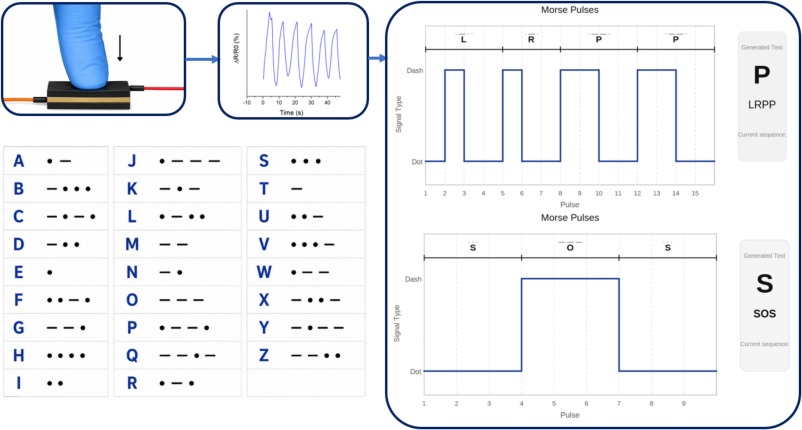
Fig. 9. Digital signal processing of the TPS/CaCl2/SA flexible ionic sensor. Mechanical stimuli generate electrical pulses that are converted into Morse code sequences. Representative decoding of individual characters and complete messages demonstrates the capability of the sensor to transform mechanical inputs into interpretable digital information.
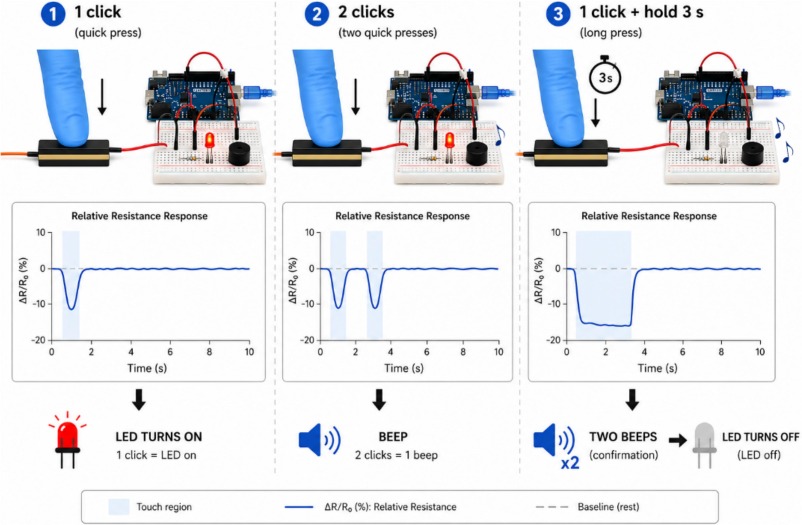
Fig. 10. Demonstration of human–machine interaction using the TPS/CaCl2/SA flexible ionic sensor. Different touch patterns (single click, double click, and long press) generate distinct electrical signatures that are recognized and converted into programmable electronic commands, enabling activation of different output functions.
Incorporating sodium alginate into TPS/CaCl2 enabled mechanical reinforcement alongside a substantial increase in ionic conductivity, demonstrating that these properties can be improved together within a plasticized polysaccharide matrix. As SA content increased from 0 to 9 phr, Young's modulus rose from 0.22 to 0.38 MPa and conductivity increased nearly twelvefold, reaching (5.63 ± 0.24) × 10−2 S cm−1. This improvement was accompanied by reduced extensibility, with elongation at break decreasing from 151.6% to 88.7%, while tensile strength reached its maximum at 6 phr SA. The combined observations support a proposed supramolecular framework involving hydrogen bonding and Ca2+-carboxylate coordination. The higher mean water contents of the SA-containing formulations also indicate that hydration contributes to the interpretation of electrical performance alongside network organization. The materials retained thermally activated functionality, with approximately complete temporary shape fixation and shape recovery ratios of 87.5–93.8%. For the 9 phr SA formulation, thermally assisted healing restored 88.9% of the original tensile strength, demonstrating substantial recovery of load-bearing capacity after complete cutting. Increasing SA content nevertheless reduced the gauge factor from 4.27 to 1.70 over 0–20% strain, showing that the gains in conductivity did not translate into greater strain sensitivity. The 9 phr formulation was therefore selected for its combination of conductivity, mechanical reinforcement, and thermomechanical performance. Its repeatable responses to stretching, compression, and bending, together with capacitive touchscreen interaction and conversion of mechanical inputs into programmable commands, demonstrated its versatility as a flexible sensing element. These findings identify SA content as an effective means of tuning the balance between stiffness, conductivity, deformability, and strain sensitivity in TPS/CaCl2 materials. The proposed network model offers a molecular framework for understanding this balance, while the respective contributions of hydration, ionic composition, and intermolecular associations remain to be resolved. By combining accessible constituents, compression molding, recoverable mechanical functionality, and electrical sensing, this work provides a practical basis for further development of polysaccharide-based ionic conductors for flexible sensors and human-machine interfaces.
Válmer Azevedo de Sousa Filho: Writing – original draft, Methodology, Investigation, Formal analysis, Data curation. Priscila de Andrade Lima: Software, Investigation, Formal analysis, Data curation. Rafael Braga da Cunha: Validation, Investigation, Formal analysis, Data curation. Marcela Cristine de Alencar Lira: Visualization, Investigation, Formal analysis, Data curation. Jaini Miscilene de Araújo: Validation, Investigation, Formal analysis, Data curation. Eudesio Oliveira Vilar: Validation, Methodology, Formal analysis, Data curation. Pankaj Agrawal: Supervision, Investigation, Formal analysis, Data curation. Tomás Jeferson Alves de Mélo: Writing – review & editing, Supervision, Resources, Funding acquisition, Data curation. Gustavo de Figueiredo Brito: Writing – review & editing, Supervision, Funding acquisition, Conceptualization.
The authors declare the following financial interests/personal relationships which may be considered as potential competing interests:
Gustavo de Figueiredo Brito reports financial support was provided by National Council for Scientific and Technological Development. Tomas Jeferson Alves de Melo reports financial support was provided by National Council for Scientific and Technological Development. Rafael Braga da Cunha reports financial support was provided by National Council for Scientific and Technological Development. Marcela Cristine de Alencar Lira reports financial support was provided by Coordination for the improvement of Higher Education Personnel. Jaini Miscilene de Araujo reports financial support was provided by Coordination for the improvement of Higher Education Personnel. Tomas Jeferson Alves de Melo reports financial support was provided by Research Support Foundation of Paraíba State. Tomas Jeferson Alves de Melo reports financial support was provided by Finep. If there are other authors, they declare that they have no known competing financial interests or personal relationships that could have appeared to influence the work reported in this paper.
The authors would like to acknowledge the financial support provided by the Brazilian funding agencies Conselho Nacional de Desenvolvimento Científico e Tecnológico (CNPq), Coordenação de Aperfeiçoamento de Pessoal de Nível Superior (CAPES), Fundação de Apoio à Pesquisa do Estado da Paraíba (FAPESQ), and Financiadora de Estudos e Projetos (FINEP). CNPq (RBC – Scholarship grant number: 140643/2024-9; TJAM – Grant numbers: 405908/2021-0 and 305367/2022-6; GFB – Grant number: 402693/2023-0). FAPESQ (TJAM - Grant numbers: 3095/2021 and 2416/2023). FINEP (TJAM – grant number: 01.18.0057-00). CAPES (MCAL and JMA – Scholarship).
Data will be made available on request.
B. Song, J. Zhang, S. Hao, C. Shao, P. Fu, J. Wen, J. Yang, H. Cong, C. Pan
Multifunctional hydrogel interfaces: reshaping the future of flexible electronics
G. Jiang, W. Guo
Research progress on conductive hydrogels derived from natural biopolymers as emerging interface materials for motion detection wearable sensors
T. Zhou, H. Li, J. Mao, Z. Yi, H. Hua, A. Zhu
Multifunctional Conductive Hydrogels: Design Strategies and Applications in Wearable Sensors and Flexible Supercapacitors
F. Xie
Natural polymer starch-based materials for flexible electronic sensor development: a review of recent progress
F. Mo, Y. Lin, Y. Liu, P. Zhou, J. Yang, Z. Ji, Y. Wang
Advances in ionic conductive hydrogels for skin sensor applications
A.S. Samsudin, N.M. Ghazali, N.F. Mazuki, K. Aoki, Y. Nagao
The ionic conductivity and electrochemical performance of alginate-PVA based polymer electrolyte with Li+ charge carriers for supercapacitor
Y. Zhang, Q. Tang, J. Zhou, C. Zhao, J. Li, H. Wang
Conductive and eco-friendly biomaterials-based hydrogels for noninvasive epidermal sensors: a review
Z.-P. Du, J. Wang, J.-W. Zhang, M.-H. Li, C.-Q. Yan
Wearable bioelectronics enabled by conductive hydrogels: from materials innovation to clinical translation
Z. Zhang, B. Feng, J. Yan, W. Zhao, J. Sun
Advances in bio-based wearable flexible sensors
X. Yan, J. Zhang, Y. Sheng, K. Chen, H. Zhao, Q. Zhang, Y. Cheng, Z. Ge, X. Ming, Y. Zhang
Decoupling the trade-off between mechanical properties and ionic conductivity in hydrogel polymer electrolytes by anomalous water-induced microphase separation
B. Yiming, Z. Jia, C. Creton
Stretchable ionic conductors: balancing mechanical properties and ionic conductivity
X. Dang, S. Han, J. Tang, X. Wang
Functional starch-based conductive hydrogel for flexible electronics: design, construction, and applications
Y. Lin, A. Wu, Y. Zhang, H. Duan, P. Zhu, Y. Mao
Recent progress of nanomaterials-based composite hydrogel sensors for human–machine interactions
X. Zhang, J. Zhuo, D. Wang, X. Zhu
Supramolecular polymers for drug delivery
N. Li, S. Gu, Q. Wu, J. Wu
Shear-stiffening supramolecular polymers: fabrication, modification and application
H.Q. Peng, W. Zhu, W.J. Guo, Q. Li, S. Ma, C. Bucher, B. Liu, X. Ji, F. Huang, J.L. Sessler
Supramolecular polymers: recent advances based on the types of underlying interactions
J.G. Rosenboom, R. Langer, G. Traverso
Bioplastics for a circular economy
A. Surendren, A.K. Mohanty, Q. Liu, M. Misra
A review of biodegradable thermoplastic starches, their blends and composites: recent developments and opportunities for single-use plastic packaging alternatives
J. Ma, Y. Zhou, P. Ou, C. Zhang, Y. Wang
Preparation, performance and application - current status and trends in thermoplastic starch
R.B. da Cunha, L.B.Q. Brito, P. Agrawal, G. de F. Brito, T.J.A. de Mélo
4D printing of shape memory polyethylene terephthalate glycol/thermoplastic polyurethane (PETG/TPU) blends
A.M. Nafchi, M. Moradpour, M. Saeidi, A.K. Alias
Thermoplastic starches: properties, challenges, and prospects
J. Alvarez-Ramirez, J. Vazquez-Arenas, A. García-Hernández, E.J. Vernon-Carter
Improving the mechanical performance of green starch/glycerol/Li+ conductive films through cross-linking with Ca2+
Y. Liu, J. Li, Z. Liang, J. Wang, Q. Pan
Preparation of double cross-linked starch/CaCl2/PVA conductive hydrogel for flexible solid-state supercapacitor
X. Zhang, X. Jiang, T. Jiang, L. Gan, X. Zhang, H. Dai
The plasticizing mechanism and effect of calcium chloride on starch/poly(vinyl alcohol) films
C. yan Su, D. Li, L. jun Wang, Y. Wang
Green double crosslinked starch-alginate hydrogel regulated by sustained calcium ion-gluconolactone release for human motion monitoring
P. Liu, C. Ma, Y. Li, L. Wang, L. Wei, Y. Yan, F. Xie
Facile preparation of eco-friendly, flexible starch-based materials with ionic conductivity and strain-responsiveness
Y. Li, P. Liu, C. Ma, N. Zhang, X. Shang, L. Wang, F. Xie
Structural disorganization and chain aggregation of high-amylose starch in different chloride salt solutions
C. Ma, F. Xie, L. Wei, C. Zheng, X. Liu, L. Wang, P. Liu
All-starch-based hydrogel for flexible electronics: strain-sensitive batteries and self-powered sensors
K. Xu, L. Tan, H. Sun, C. Chong, L. Li, B. Sun, Z. Yao, Y. Zhuang, L. Wang
Manipulating gelatinization, retrogradation, and hydrogel properties of potato starch through calcium chloride-controlled crosslinking and crystallization behavior
G. Guan, Y. Shen, J. Feng, K. Fan
Study on the effects of starch-based calcium chloride-glycerol conductive coating on copper electrodes on soil electroosmotic performance
G.T. Grant, E.R. Morris, D.A. Rees, P.J.C. Smith, D. Thom
Biological interactions between polysaccharides and divalent cations: the egg-box model
I. Braccini, S. Pérez
Molecular basis of Ca2+-induced gelation in alginates and Pectins: the egg-box model revisited
I. Donati, B.E. Christensen
Alginate-metal cation interactions: macromolecular approach
S. Fadhilah bt Ibrahim, N. Aisyah Nasuha Mohd Azam, K. Anuar Mat Amin
Sodium alginate film: the effect of crosslinker on physical and mechanical properties
A. Cano-Vicent, A. Tuñón-Molina, H. Bakshi, R. Sabater i Serra, I.M. Alfagih, M.M. Tambuwala, Á. Serrano-Aroca
Biocompatible alginate film crosslinked with Ca2+ and Zn2+ possesses antibacterial, antiviral, and anticancer activities
M. Kuzmanović, D.K. Božanić, D. Milivojević, D.M. Ćulafić, S. Stanković, C. Ballesteros, J. Gonzalez-Benito
Sodium-alginate biopolymer as a template for the synthesis of nontoxic red emitting Mn2+-doped CdS nanoparticles
S. Chen, T. Duan, X. Lou, Y. Sun, Y. Chen, X. Wang, T. Wang, Y. Gao, G. Gao
Sodium alginate-based eutectogel fibers with high-speed ion channels with extreme environmental resilience and high-resolution for multi-environmental stimuli responses
R. da Silva Fernandes, F.N. Tanaka, M.R. de Moura, F.A. Aouada
Development of alginate/starch-based hydrogels crosslinked with different ions: hydrophilic, kinetic and spectroscopic properties
C. yan Su, D. Li, L. jun Wang
From micropores to mechanical strength: fabrication and characterization of edible corn starch-sodium alginate double network hydrogels with Ca2+ cross-linking
L.M. Fonseca, J.P. de Oliveira, P.D. de Oliveira, E. da Rosa Zavareze, A.R.G. Dias, L.T. Lim
Electrospinning of native and anionic corn starch fibers with different amylose contents
S.N. Cavalcanti, M.P. da Silva, T.A.C.S. Rodrigues, P. Agrawal, G.F. Brito, E.O. Vilar, T.J.A. Mélo
Application of artificial neural networks as a tool for the prediction of electrical conductivity in polymer composites
F.R.S. Sousa, H.G.M. Dantas, R.B. da Cunha, M.C. de A. Lira, V.A. de Sousa Filho, J.M. de Araújo, C.T.C. Cunha, G. de F. Brito, P. Agrawal, T.J.A. de Mélo
4D printing of multifunctional PCL/E-GMA/CB composites exhibiting triple-shape memory, electrically triggered shape memory, and self-healing
I. Miccoli, F. Edler, H. Pfnür, C. Tegenkamp
The 100th anniversary of the four-point probe technique: the role of probe geometries in isotropic and anisotropic systems
M. Morita, F. Matsumura, T. Shikata, Y. Ogawa, N. Kondo, K. Shiraga
Hydrogen-bond configurations of hydration water around glycerol investigated by HOH bending and OH stretching analysis
M.C. de A. Lira, V.A. de Sousa Filho, R.B. da Cunha, J.M. de Araújo, P. Agrawal, G. de F. Brito, T.J.A. de Mélo
4D printing behavior of PETG/SEBS blends: a comparative study of reactive and non-reactive SEBS with varied styrene content
R.B. da Cunha, L.B.Q. Brito, P. Agrawal, G.F. de Brito, T.J.A. de Mélo
Recyclable catalyst-free elastomeric vitrimers: dynamic covalent bonds in ethylene-glycidyl methacrylate/zinc ionomer of ethylene/ methacrylic acid blends
R.B. da Cunha, P. Agrawal, A. da Silva Lúcio, C.T.C. Cunha, G. de Figueiredo Brito, T.J.A. de Mélo
Evaluation of shape memory and self-healing of poly(ε-caprolactone)/poly(ethylene-co-methacrylic acid) ionomer (PCL/EMAA-Zn) blends
V.A. de Sousa Filho, M.C. de A. Lira, R.L.P. Bonfim, R.B. da Cunha, S.N. Cavalcanti, L.B.Q. Brito, P. Agrawal, G. de F. Brito, T.J.A. de Mélo
Reactive and non-reactive compatibilization of polyethylene terephthalate glycol/thermoplastic polyurethane (PETG/TPU) blends for 3D/4D printing applications
H.G.M. Dantas, F.R.S. Sousa, T.A.C.S. Rodrigues, R.L.P. Bonfim, R.B. da Cunha, S.N. Cavalcanti, M.C. de A. Lira, V.A. de Sousa Filho, J.M. de Araújo, F.R. Pê, P. Agrawal, G. de F. Brito, T.J.A. de Mélo
Multifunctional PLA/E-GMA/CB conductive polymer composites exhibiting enhanced toughness, electrically triggered shape memory, and EMI shielding
R.B. da Cunha, S.N. Cavalcanti, P. Agrawal, G.F. Brito, T.J.A. Mélo
Evaluation of shape memory effect in PLA/copolymers blends
K. Yang, X. Luo, Y. Zhai, J. Liu, K. Chen, X. Shao, X. Wu, Y. Li, Z. Chen
Influence of sodium alginate on the gelatinization, rheological, and retrogradation properties of rice starch
L. Xu, B. Li, B. Wan, H. Yang, Y. Ke, B. Zhu, D. Qiu
Supramolecular interaction mediated affine deformation for energy-dissipative stiff hydrogel
M.C. de A. Lira, R.B. da Cunha, P. Agrawal, G.F. de Brito, T.J.A. de Mélo
Shape memory effect in supertough PETG/EGMA thermoplastic vulcanizates obtained through dynamic vulcanization and interfacial compatibilization
J. Girón-Hernández, P. Gentile, M. Benlloch-Tinoco
Impact of heterogeneously crosslinked calcium alginate networks on the encapsulation of β-carotene-loaded beads
B.A. Harper, S. Barbut, A. Smith, M.F. Marcone
Mechanical and microstructural properties of “wet” alginate and composite films containing various carbohydrates
P. Kiattijiranon, R.A. Auras, A. Sane
Enhanced functional properties for packaging applications using sodium alginate/starch bilayer and multilayer films
H. Zhou, N. Yang, J. Hou, C. Yu, Z. Jin, P. Zeng, L. Yang, Y. Fu, Y. Shen, S. Guo
Effects of CaCl2, HCl, acetic acid or citric acid on dynamic mechanical performances and physicochemical properties of sodium alginate edible films
C. Löwenberg, M. Balk, C. Wischke, M. Behl, A. Lendlein
Shape-memory hydrogels: evolution of structural principles to enable shape switching of hydrophilic polymer networks
A. Naeem, C. Yu, L. Zhou, Y. Xie, Y. Weng, Y. Huang, M. Zhang, Q. Yang
Shape memory hydrogels in tissue engineering: recent advances and challenges
R.B. Cunha, F.R. Pê, P. Agrawal, G.F. Brito, T.J.A. Mélo
Influence of crystallization on the shape memory effect of poly (lactic acid)
J.M. de Araújo, R. Lucas Pereira Bonfim, R.B. da Cunha, M.C. de A. Lira, V.A. de Sousa Filho, P. Agrawal, C.T.C. Cunha, G. de F. Brito, T.J.A. de Mélo
4D printing of multi-responsive shape memory polymers: PCL/POE blends with Fe3O4 activation via infrared, microwave, and thermal stimuli
J.M. De Araújo, M.C. de A. Lira, R.B. da Cunha, V.A. De Sousa Filho, S.N. Cavalcanti, C.T.C. Cunha, P. Agrawal, T.J.A. De Mélo, G. de F. Brito
4D printing of TPU/PCL/Fe3O4 composites exhibiting multi-stimuli responsive shape memory behavior
W. Wang, L. Shen, Y. Si, I.M.D. Zahidul, A. Abdullaev, Y. Dong
Calcium alginate film with excellent shape memory effect
M. Qi, Y. Han, W. Zhang, Y. Liu, D. Jiang, Z. Wu, M. Xu, J. Fu, B. Li
Advances and future perspectives in hydrogel-based sensing technologies: a comprehensive review
D. Ji, J.M. Park, M.S. Oh, T.L. Nguyen, H. Shin, J.S. Kim, D. Kim, H.S. Park, J. Kim
Superstrong, superstiff, and conductive alginate hydrogels
X. Di, Q. Ma, Y. Xu, M. Yang, G. Wu, P. Sun
High-performance ionic conductive poly(vinyl alcohol) hydrogels for flexible strain sensors based on a universal soaking strategy
Y. Zhou, Z. Xie, F. Wu, J. Qin, X. Zhang, J. Zhang, X. Ma, L. Fan, X. Wang, J. Wang, T. Tan, C. Lu
Facile fabrication and characterization of double network starch/PVA/NaCl composite hydrogel for flexible strain sensor
Y. Li, X. Wen, X. Li, M. Zahid, H. Wang, J. Zhang
Design of super stretchability, rapid self-healing, and self-adhesion hydrogel based on starch for wearable strain sensors
K. Lu, X. He, D. Burhani, J. Hu, P. Rudolf, D. Maniar, R. Folkersma, V.S.D. Voet, K. Loos
Self-healing, remoldable, and conductive starch-based dual reversible cross-linking hydrogels for strain sensors
Y. Liu, D. Jiang, Z. Wu, B. Jiang, Q. Xu
Highly conductive and sensitive acrylamide-modified carboxymethyl cellulose/polyvinyl alcohol composite hydrogels for flexible sensors
来源 查看原文
版权申明 本网站立足国家海洋药物和生物制品产业联盟,致力于打造海洋生物医药“产学研用”一站式、综合性资讯共享服务平台,促进我国海洋药物和功能制品“资源链、科技链、产业链、应用链”协同创新、深度融合发展。本文转载自原文来源。版权归原作者及原来出处所有,部分文章未能联系到原作者,在此深表歉意。如涉及版权问题,请留言联系我们协商处理(邮箱:czhang@tio.org.cn),侵权内容将即刻删除。
免责声明 本文仅代表作者个人观点,与本平台立场无关。本站不对内容真实性、完整性、时效性作保证,仅供参考,请读者自行核实。