
Abrupt climate changes have affected rainfall patterns worldwide in the past, especially in the tropical monsoon region, a new study shows. An international team of scientists used dripstones from globally distributed caves together with model simulations to analyse the global impacts of rapid Northern-Hemisphere temperature increases, the widely studied Dansgaard-Oeschger events, that repeatedly occurred during the last ice age. The comparison of stalagmite and model data shows in unprecedented detail how these abrupt changes and the associated modifications of the Atlantic overturning circulation, AMOC for short, have affected global atmospheric circulation.
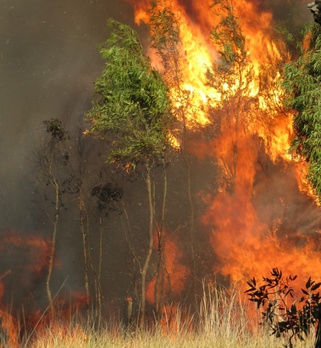
Global warming and drastic deforestation could dry out the Amazon rainforest faster and enforce the risk of keeping it downright fire-trapped. A new study published in Nature Communications Earth and Environment shows: Fire can be a decisive factor for a potential tipping of the Amazon rainforest, as it is capable of locking large parts of the Amazon in a treeless state. While naturally not occurring in rainforests, fire can play an increasing role once the forest is damaged, thinned or completely lost, up to a status where fire is the dominating driver of the ecosystem.
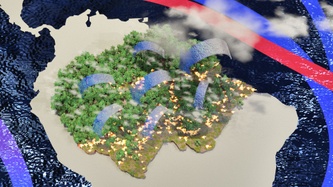
For every three trees dying from drought in the Amazon rainforest, a fourth tree – even though not directly affected – will die, too. In simplified terms, that’s what researchers have now found using network analysis to understand the complex workings of one of Earth’s most valuable and biodiverse carbon sinks. The regions most at risk of turning into savannah are located on the forest’s Southern fringes, where continuous clearing for pasture or soy has already been weakening the forest’s resilience for years.

Helping to limit anthropogenic global warming should be a prime task of science in the 2020s. “The coming decade must focus on climate change”, states a recent editorial of the world-leading scientific journal Nature. The 2010s saw breakthroughs in artificial intelligence via deep-learning technologies, in life sciences through the reprogramming of mature cells into stem cells, in physics with gravitational-wave detection and progress on quantum computing. While this was remarkable, the editors proclaim that “with new knowledge, and a renewed dedication to social and environmental responsibility, the 2020s must be transformational”.
