The hurricane-induced decay of mesoscale eddies: an energy source for near-inertial waves
2025-12-27
Qianqian Ren, Yu Zhang, Wei Wang
Abstract
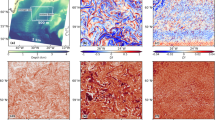
Oceanic mesoscale eddies represent the most energetic component of the ocean circulation; however, their decay routes remain elusive, leaving a key gap in our understanding of the oceanic energy cascade. Here we combine satellite data with mooring measurements from the South China Sea in 2014 to reveal a rapid decay of oceanic eddies following the passage of typhoons. This decay is accompanied by a substantial generation of internal waves with near-inertial frequency in the ocean interior. The temporal correspondence and quantitatively commensurate energy changes indicate a direct energy transfer from eddy to internal wave field. We propose that typhoon-induced perturbations trigger an adjustment process within the eddy, resulting in energy loss through the radiation of near-inertial waves. Quantitatively supported by numerical model simulations, this mechanism plays a crucial role in the evolution of mesoscale eddies and points to a previously overlooked interior source of oceanic internal waves.
Data availability
All the data used directly for generating the figures in this study are archived at https://doi.org/10.5281/zenodo.17221258. The MASCS 1.0 dataset37 used in this paper are available at https://zenodo.org/records/12635331. The IBTrACS dataset38,39 are available at https://www.ncei.noaa.gov/products/international-best-track-archive. The sea level anomaly data distributed by AVISO are available at https://doi.org/10.48670/moi-00148. The surface drifter data64 are provided by the Drifter Data Assembly Center of National Oceanic and Atmospheric Administration (https://www.aoml.noaa.gov/phod/gdp/interpolated/data/all.php). The Argo profiling floats data59 are collected and made freely available by the international Argo Program and the national programs that contribute to it (https://argo.ucsd.edu, https://www.ocean-ops.org), as part of the Global Ocean Observing System. The WOA18 data60 can be downloaded from https://www.ncei.noaa.gov/products/world-ocean-atlas.
Code availability
The MITgcm model components are open source, which can be downloaded from https://mitgcm.org/source-code. The configuration of model simulations and the code for analysis in the study can be obtained from https://doi.org/10.5281/zenodo.17221258. The MATLAB_R2024b is used for plotting.
References
Ferrari, R. & Wunsch, C. Ocean circulation kinetic energy: reservoirs, sources, and sinks. Annu. Rev. Fluid Mech. 41, 253–282 (2009).
Dong, C., McWilliams, J. C., Liu, Y. & Chen, D. Global heat and salt transports by eddy movement. Nat. Commun. 5, 1–6 (2014).
Chelton, D. B., Schlax, M. G., Samelson, R. M. & de Szoeke, R. A. Global observations of large oceanic eddies. Geophys. Res. Lett. 34, L15606 (2007).
Chelton, D. B., Schlax, M. G. & Samelson, R. M. Global observations of nonlinear mesoscale eddies. Prog. Oceanogr. 91, 167–216 (2011).
Zhang, Z., Zhang, Y., Wang, W. & Huang, R. X. Universal structure of mesoscale eddies in the ocean. Geophys. Res. Lett. 40, 3677–3681 (2013).
Zhang, Z., Wang, W. & Qiu, B. Oceanic mass transport by mesoscale eddies. Science 345, 322–324 (2014).
Charney, J. G. Geostrophic turbulence. J. Atmos. Sci. 28, 1087–1095 (1971).
Wunsch, C. & Ferrari, R. Vertical mixing, energy, and the general circulation of the oceans. Annu. Rev. Fluid Mech. 36, 281–314 (2004).
Zhai, X. & Greatbatch, R. J. Wind work in a model of the northwest Atlantic Ocean. Geophys. Res. Lett. 34, 1–4 (2007).
Hughes, C. W. & Wilson, C. Wind work on the geostrophic ocean circulation: an observational study of the effect of small scales in the wind stress. J. Geophys. Res. Oceans 113, C02016 (2008).
Reznik, G. M. & Grimshaw, R. Nonlinear geostrophic adjustment in the presence of a boundary. J. Fluid Mech. 471, 257–283 (2002).
Zhai, X., Johnson, H. L. & Marshall, D. P. Significant sink of ocean-eddy energy near western boundaries. Nat. Geosci. 3, 608–612 (2010).
Polzin, K. L. Mesoscale eddy-internal wave coupling. Part II: energetics and results from polyMode. J. Phys. Oceanogr. 40, 789–801 (2010).
Xie, J. H. & Vanneste, J. A generalised-Lagrangian-mean model of the interactions between near-inertial waves and mean flow. J. Fluid Mech. 774, 143–169 (2015).
Thomas, L. N. On the modifications of near-inertial waves at fronts: implications for energy transfer across scales. Ocean Dyn. 67, 1335–1350 (2017).
Marshall, D. P. & Naveira Garabato, A. C. A conjecture on the role of bottom-enhanced diapycnal mixing in the parameterization of geostrophic eddies. J. Phys. Oceanogr. 38, 1607–1613 (2008).
Nikurashin, M., Vallis, G. K. & Adcroft, A. Routes to energy dissipation for geostrophic flows in the Southern Ocean. Nat. Geosci. 6, 48–51 (2013).
Xie, X. et al. Pure inertial waves radiating from low-frequency flows over large-scale topography. Geophys. Res. Lett. 50, e2022GL099889 (2023).
de Marez, C., Meunier, T., Tedesco, P., L’Hégaret, P. & Carton, X. Vortex-wall interaction on the β-plane and the generation of deep submesoscale cyclones by internal Kelvin waves-current interactions. Geophys. Astrophys. Fluid Dyn. 114, 588–606 (2020).
Capet, X., McWilliams, J. C., Molemaker, M. J. & Shchepetkin, A. F. Mesoscale to submesoscale transition in the California current system. Part III: energy balance and flux. J. Phys. Oceanogr. 38, 2256–2269 (2008).
Mied, R. P., Shen, C. Y., Trump, C. L. & Lindemann, G. J. Internal-inertial waves in a sargasso sea front. J. Phys. Oceanogr. 16, 1751–1762 (1986).
Molemaker, M. J., McWilliams, J. C. & Yavneh, I. Baroclinic instability and loss of balance. J. Phys. Oceanogr. 35, 1505–1517 (2005).
Molemaker, M. J., McWilliams, J. C. & Capet, X. Balanced and unbalanced routes to dissipation in an equilibrated Eady flow. J. Fluid Mech. 654, 35–63 (2010).
Thomas, L. N. On the effects of frontogenetic strain on symmetric instability and inertia-gravity waves. J. Fluid Mech. 711, 620–640 (2012).
Shakespeare, C. J. & Taylor, J. R. A generalized mathematical model of geostrophic adjustment and frontogenesis: uniform potential vorticity. J. Fluid Mech. 736, 366–413 (2013).
Shakespeare, C. J. & Taylor, J. R. The spontaneous generation of inertia-gravity waves during frontogenesis forced by large strain: numerical solutions. J. Fluid Mech. 772, 508–534 (2015).
Williams, P. D., Haine, T. W. N. & Read, P. L. Inertia-gravity waves emitted from balanced flow: observations, properties and consequences. J. Atmos. Sci. 65, 3543–3556 (2008).
Vanneste, J. Balance and spontaneous wave generation in geophysical flows. Annu. Rev. Fluid Mech. 45, 147–172 (2013).
Johannessen, O. M., Sandven, S., Chunchuzov, I. P. & Shuchman, R. A. Observations of internal waves generated by an anticyclonic eddy: a case study in the ice edge region of the Greenland Sea. Tellus A Dyn. Meteorol. Oceanogr. 71, 1–12 (2019).
Zhao, B., Xu, Z., Li, Q., Wang, Y. & Yin, B. Transient generation of spiral inertia-gravity waves from a geostrophic vortex. Phys. Fluids 33, 032119 (2021).
Zhang, Y., Zhang, Z., Chen, D., Qiu, B. & Wang, W. Strengthening of the Kuroshio current by intensifying tropical cyclones. Science 368, 988–993 (2020).
Ni, X., Zhang, Y. & Wang, W. Hurricane influence on the oceanic eddies in the Gulf Stream region. Nat. Commun. 16, 583 (2025).
Blumen, W. Geostrophic adjustment. Rev. Geophys. Sp. Phys. 10, 485–528 (1972).
Reznik, G. M., Zeitlin, V. & Ben Jelloul, M. Nonlinear theory of geostrophic adjustment. Part 1. Rotating shallow-water model. J. Fluid Mech. 445, 93–120 (2001).
Zeitlin, V., Reznik, G. M. & Jelloul, M. Ben. Nonlinear theory of geostrophic adjustment. Part 2. Two-layer and continuously stratified primitive equations. J. Fluid Mech. 491, 207–228 (2003).
Jaimes, B. & Shay, L. K. Near-inertial wave wake of Hurricanes Katrina and Rita over mesoscale oceanic eddies. J. Phys. Oceanogr. 40, 1320–1337 (2010).
Zhang, H. et al. MASCS 1.0: synchronous atmospheric and oceanic data from a cross-shaped moored array in the northern South China Sea during 2014–2015. Earth Syst. Sci. Data 16, 5665–5679 (2024).
Knapp, K. R., Kruk, M. C., Levinson, D. H., Diamond, H. J. & Neumann, C. J. The international best track archive for climate stewardship (IBTrACS): unifying tropical cyclone best track data. Bull. Am. Meteor. Soc. 91, 363–376 (2010).
Knapp, K. R., Diamond, H. J., Kossin, J. P., Kruk, M. C. & Schreck, C. J. International best track archive for climate stewardship (IBTrACS) project, version 4. NOAA national centers for environmental information. https://doi.org/10.25921/82ty-9e16 (2018).
Pujol, M. et al. DUACS DT2014: the new multi-mission altimeter data set reprocessed over 20 years. Ocean Sci. 12, 1067–1090 (2016).
Liu, G. et al. Energy Transfer Between Mesoscale Eddies and Near-Inertial Waves from Surface Drifter Observations. Geophys. Res. Lett. 50, 1–11 (2023).
Gill, A. E. On the behavior of internal waves in the wakes of storms. J. Phys. Oceanogr. 14, 1129–1151 (1984).
Price, J. F. Upper ocean response to a hurricane. J. Phys. Oceanogr. 11, 153–175 (1987).
Alford, M. H., Cronin, M. F. & Klymak, J. M. Annual cycle and depth penetration of wind-generated near-inertial internal waves at Ocean Station Papa in the Northeast Pacific. J. Phys. Oceanogr. 42, 889–909 (2012).
Simmons, H. L. & Alford, M. H. Simulating the long-range swell of internal waves generated by ocean storms. Oceanography 25, 30–41 (2012).
Kunze, E. Near-inertial wave propagation in geostrophic shear. J. Phys. Oceanogr. 15, 544–565 (1985).
Alford, M. H., Mackinnon, J. A., Simmons, H. L. & Nash, J. D. Near-inertial internal gravity waves in the ocean. Ann. Rev. Mar. Sci. 8, 95–123 (2016).
Leaman, K. D. & Sanford, T. B. Vertical energy propagation of inertial waves: a vector spectral analysis of velocity profiles. J. Geophys. Res. 80, 1975–1978 (1975).
Klein, P. et al. Diagnosis of vertical velocities in the upper ocean from high resolution sea surface height. Geophys. Res. Lett. 36, 1–5 (2009).
Okubo, A. Horizontal dispersion of floatable particles in vicinity of velocity singularities such as convergences. Deep-Sea Res. 17, 445–454 (1970).
Weiss, J. The dynamics of enstrophy transfer in two-dimensional hydrodynamics. Phys. D. 48, 273–294 (1991).
Nikurashin, M. & Ferrari, R. Radiation and dissipation of internal waves generated by geostrophic motions impinging on small-scale topography: theory. J. Phys. Oceanogr. 40, 1055–1074 (2010).
Huang, N. E. et al. The empirical mode decomposition and the Hilbert spectrum for nonlinear and non-stationary time series analysis. Proc. R. Soc. A Math. Phys. Eng. Sci. 454, 903–995 (1998).
Rossby, C.-G. On the mutual adjustment of pressure and velocity distributions in certain simple current systems, II. J. Mar. Res. 1, 239–263 (1938).
Cahn, A. Jr. An investigation of the free oscillations of a simple current system. J. Meteorol. 2, 113–119 (1945).
Lee, D.-K. & Niiler, P. P. The inertial chimney: the near-inertial energy drainage from the ocean surface to the deep layer. J. Geophys. Res. 103, 7579–7591 (1998).
Lelong, M. P., Cuypers, Y. & Bouruet-Aubertot, P. Near-inertial energy propagation inside a Mediterranean anticyclonic eddy. J. Phys. Oceanogr. 50, 2271–2288 (2020).
Chen, Z. et al. Downward propagation and trapping of near-inertial waves by a westward-moving anticyclonic eddy in the subtropical northwestern Pacific Ocean. J. Phys. Oceanogr. 53, 2105–2120 (2023).
Wong, A. P. S. et al. Argo data 1999–2019: two million temperature-salinity profiles and subsurface velocity observations from a global array of profiling floats. Front. Mar. Sci. 7, 1–23 (2020).
Garcia, H. E. et al. World Ocean Atlas 2018: product documentation. https://www.ncei.noaa.gov/sites/default/files/2022-06/woa18documentation.pdf (2019).
Isern-Fontanet, J., García-Ladona, E. & Font, J. Identification of marine eddies from altimetric maps. J. Atmos. Ocean. Technol. 20, 772–778 (2003).
Gill, A. E. Atmosphere-Ocean Dynamics. (Academic Press, 1982).
Nash, J. D., Alford, M. H. & Kunze, E. Estimating internal wave energy fluxes in the ocean. J. Atmos. Ocean. Technol. 22, 1551–1570 (2005).
Lumpkin, R. & Centurioni, L. Global drifter Program quality-controlled 6-hour interpolated data from ocean surface drifting buoys. NOAA National Centers for Environmental Information. Dataset. Accessed 2024-08-31 (2019).
Acknowledgements
This work was supported by the National Natural Science Foundation of China through Grant 42288101 of Y. Zhang and W. Wang.
Author information
Authors and Affiliations
Contributions
Y. Z. and W. W. conceived the project and developed data analysis methodology. Q. R. carried out data analyses and the model simulation, and wrote the manuscript. Y. Z. and W. W. reviewed and edited the manuscript.
Corresponding authors
Ethics declarations
Competing interests
The authors declare no competing interests.
Peer review
Peer review information
Communications Earth and Environment thanks the anonymous reviewers for their contribution to the peer review of this work. Primary Handling Editors: José Luis Iriarte Machuca and Alireza Bahadori. A peer review file is available.
Additional information
Publisher’s note Springer Nature remains neutral with regard to jurisdictional claims in published maps and institutional affiliations.
Supplementary information
Rights and permissions
Open Access This article is licensed under a Creative Commons Attribution-NonCommercial-NoDerivatives 4.0 International License, which permits any non-commercial use, sharing, distribution and reproduction in any medium or format, as long as you give appropriate credit to the original author(s) and the source, provide a link to the Creative Commons licence, and indicate if you modified the licensed material. You do not have permission under this licence to share adapted material derived from this article or parts of it. The images or other third party material in this article are included in the article’s Creative Commons licence, unless indicated otherwise in a credit line to the material. If material is not included in the article’s Creative Commons licence and your intended use is not permitted by statutory regulation or exceeds the permitted use, you will need to obtain permission directly from the copyright holder. To view a copy of this licence, visit http://creativecommons.org/licenses/by-nc-nd/4.0/.
About this article

Cite this article
Ren, Q., Zhang, Y. & Wang, W. The hurricane-induced decay of mesoscale eddies: an energy source for near-inertial waves. Commun Earth Environ (2025). https://doi.org/10.1038/s43247-025-03113-3
Received:
Accepted:
Published:
DOI: https://doi.org/10.1038/s43247-025-03113-3